Say Yes to Twitter

I was watching this video from the Kaiser’s Toilet on Twitter and Google’s new Buzz – and it got me thinking. Much of the discussion that we see around social media, marketing and new technologies relates to yes/no decisions. The conversations are framed in terms of scarcity – of time, resources, budget and so on. But one of the fundamental transformations that the social web has driven is that of abundance. Of information, knowledge and connection.

So we are seeing a fundamental disconnect between the way that we VIEW this emerging world and the way that it OPERATES.

Say yes to Twitter from Marcus Brown on Vimeo.

The idea of VIEWING a website or social platform is a behaviour that has created a world view. It comes from 50 years of broadcast TV. It places us, “a user” (and therefore a dependent) in a passive mode. The newer, social web places us, the PARTICIPANT at the centre of a hub. It requires choice, it engenders responsibility, and presupposes action. It PLAYS to the concept of abundance and see scarcity as outmoded, traditional, passe.

But as Mark Earl’s Herd has taught us, it is behaviour which changes thinking, not thinking that changes behaviour. So perhaps, surreptitiously, our engagement with the social web may have wider implications. Or maybe the social web is more chaotic, playful and unpredicatable than our marketing and IT “use cases” would suggest.

This interesting article by Alan Wolk shows how the #thuglife meme has made Twitter into a purely experiential platform. More importantly for marketers, perhaps, is the scale of this type of participation – which far exceeds the early adopter circles that characterise much of the social media debate:

It's an interesting use of the medium, and the people participating in these hashtags seem to be getting as much value out of them as the Twitter-Is-a-Serious-Business-Tool types who busily append words like "Genius!" to their retweets of a fellow blogger's "Top 10 Reasons Location-Based Services Are the New Twitter."

What we are seeing is the logical extension of YES. We are seeing the “crowd” embracing abundance and participating in a way which is consciously unselfconscious.

What would happen if we did the same? What if we said YES to Twitter? What would happen if we followed everyone? Would our world change? Maybe not. But maybe WE would.

Shipwrecks, Tides, Sea Monsters and Digital Strategy

Brian Solis has scoured the web and brought together a series of visual graphs, maps and statistics that seek to explain the “social web”. He calls it the State of Social Media Around the World 2010. I particularly like The Global Web Index by Trendstream which goes beyond the aggregated data points to show just exactly HOW people are using social technologies in each country. However, in reading this type of data – it often pays to cross-match data points and superimpose other frameworks to reveal more useful information. This is essential to helping you formulate a robust digital strategy. Let's see how.

Superimposing frameworks to reveal information

socialweb2

It is interesting to compare this against Forrester’s Ladder of Social Media Participation (or see the latest version incorporating “conversationalists”) which is more granular. Forums, in particular, are still a powerful way for people to participate in a community – and are extremely popular, well trafficked and often vibrant. 

ForresterLadder Conversation

Reading Maps 

I love maps. They are a great way of contextualising our world. But it's also important to remember that they have a long history – and an important function in the sharing of knowledge. Whenever I see a map, I always think of navigation. I think of sea monsters, reefs and shipwrecks. So for all the great information that is shown on a map – it's just important to look for what is not shown, what is just below the surface.

For example, there are a couple of ways of looking at this map:

  • Trends and tides: The colour coding helps to easily identify global and regional trends. Think of this in terms of a tide – what is coming in and what is going out. Clearly photo uploading is a global phenomenon with wide scale adoption. Is it at the high tide mark? Does that matter to your audience? Designing a strategy that incorporates photography, image sharing etc lowers the barrier to entry – but can also be seen as "old hat".
  • Sea monsters: Take a close look at your country and region. The variations from global trend can indicate potential roadblocks. Think about what is happening in your country/region and determine the root causes? Not uploading video in your neck of the woods? Is there good (and cheap) bandwidth available? Are devices such as the Flip video readily available? Remember, ease of use drives consumption – that includes devices as well as websites.
  • Shipwrecks: What can be learned from the lessons of others? This is where historical and trend data can be useful. Is there 2007 or 2008 data that you can draw upon to show shifts in patterns of behaviour? Are your audiences doing something more rather than less? What is it? What are the lessons from overseas that you can take into account in your own plans?  

global-Map-of-Social-Web-In

Oz-SocialInvolvement The Australian figures, for example are fascinating. We now know that Australians are the number one users of social media worldwide. But we are seeing particular usage patterns emerging – which would characterise us mostly as joiners and spectators. It is still a relatively small percentage who create content.

When it comes to developing a strategy for your brand, it’s important to understand the differences in the platforms and how it influences behaviour – because knowing who drives knowing how. We need to determine not just where our audiences lie (and the numbers), but also identify the most appropriate form of engagement. A joiner is not going to contribute a video to your competition, and a conversationalist is not an optimal target for a podcast. Think also about simple social media – it’s a great way to easily map what you currently do onto a more social framework (something I will be writing about later this week).

But above all – read statistics with a critical eye. Just because you read something on the web or in a report, doesn't mean it is true. It's an opinion. And when it comes to your brand's or client's strategy, your insight and your opinion also count.

Being Playful – From Poseur to Flaneur

Regular readers will know that I love the idea of play. In fact, I love it so much I built a mnemonic around it – the P-L-A-Y framework for storytelling. But “play” goes so much further for me – it goes to the very heart of our existence. It manifests as what theorists would call a “libidinal drive” – something that compels us to do something – an action that creates an exchange.

But to “be” playful means inhabiting “playfulness”. It also means letting playfulness inhabit you. In many ways, this is what we call “personality” – those traits that show through while you are being yourself – being playful. Being serious.

Russell Davies has a great post on being playful – which actually leads in a different direction from what I was expecting (surprise #1). Rather than investigating playfulness, he looks, instead at “pretending” – and how our various consumer purchases open the door to our imaginary life.

Think, for example, of the link between an iPhone and a Star Trek communicator (so thoughtfully captured in this image!). You can’t tell me that iPhone and other gadget users don’t get a secret buzz out of living out their childhood fantasies. Brands that win are able to facilitate a sense of transference – allowing us to put ourselves into an imaginary space and project an alternative vision of ourselves. After all, I may ride a Ducati (or used to), but I’m never going to be a MotoGP world champion. As Russell points out:

But it's not just a matter of dressing up. A successful pretending object has to delicately balance pretending affordance with not making you look like an idiot. That's why so many successful pretending objects are also highly functional.

If the “pretending object” goes too far – it does indeed make us look idiotic. We become poseurs – mere representations of something more serious. But of the pretending object doesn’t go far enough – then it is trashed, considered lame, and discarded or ignored by its intended audience.

And this is the art in design and the fine line in communications. How do we allow people into the process of creating meaning without restricting their creativity unduly? I think the approach is to turn our “consumers” into  Flaneurs. It’s about the experience – but on another person’s terms – not ours. It’s the placing of a product/service/offering in the service of another’s contextual experience. It means that the Flaneur’s experience is paramount – and the “thing-that-is-your-brand” will be recombined, re-absorbed and recontextualised according to its use-life.

Now, that’s what I call a “value exchange”.

Simple Social Media

When I speak at conferences or try to explain “social media” to people, I fall back on what I call “simple social media”. But it wasn’t until recently that I realised that I have never written anything about it. Well not exclusively, anyway.

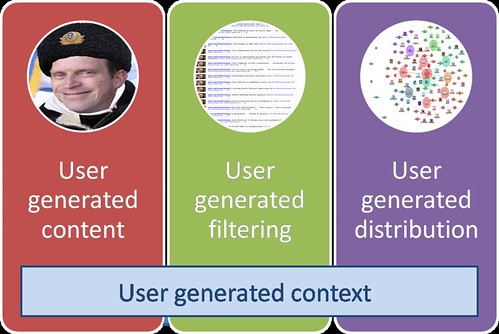
For me, social media is made up of four elements:

  1. User generated content
  2. User generated distribution
  3. User generated filtering
  4. User generated context

These four elements were first articulated for me in Michael Wesch’s video An Anthropological Introduction to YouTube. But rather than placing each of these elements on an even footing, I see CONTEXT as sitting below the others, operating as a foundation as well as a conduit.

Elements of Social Media

The thing to remember is that brands can be considered “users” here – they can provide value to the online community through the generation and creation of content, they can filter useful and relevant content for us, and they can also help it spread. BUT the real value lies in them creating the CONTEXT in which this value is maximised. If a brand can do only one thing for me online – then CREATING this context is what I want. But venturing into the other sectors not just doubles – it squares the value (ie the network effect kicks in immediately).

Social media has the capacity to EXPONENTIALLY grow the sense of value that you provide to your community by actively working with each of these social media elements. (With thanks to Derek Markham for the E word!) But which one and when? Well, that’s where strategy and strategic planning come in.

Who says social media isn’t simple?

The New Rules of Marketing & PR – Version 2

dmscott-at-smcsyd For those of you lucky enough to have seen David Meerman Scott in action during his recent Australian visit, you will know he is a force to be reckoned with. His sharp thinking and experience comes through in everything he says, his charm disarms the most strident critic and his enthusiasm sweeps you along. It also helps that he is armed with story after story of how marketers big and small have used social media to transform their businesses.

If you are, however, still to be convinced of the opportunities now available through the empowering social media technologies, then look no further than David’s new edition of The New Rules of Marketing and PR: How to Use Social Media, Blogs, News Releases, Online Video, and Viral Marketing to Reach Buyers Directly. It builds on the first edition (which has been translated into 24 languages) – with new stories, additional anecdotes and interviews. Personally, I am keen to see whether Jonathan Crossfield’s sharing of the Cotton On story made it into the new edition.

But no matter what level of experience you have with marketing, PR or social media, you will take away plenty of useful information, case studies and approaches from David’s book. It is, dare I say it, required reading.

Genealogy, Streetview and Public-Private Histories

Over the last month or so I have begun researching my family tree. It’s a fascinating research project that involves matching names with stories and stories with memories. It combines official government records with personal letters, and certificates with box brownie photos. I have been amazed at what I have been able to find – and how many traces my ancestors left as they lived their lives.

Of course, the ease with which I can find historical data relies on the digitisation efforts of various government departments around the world as well as what must be massive projects undertaken by various private businesses such as Ancestry.com and Genes Reunited who provide scans of various records from electoral rolls to immigration/passenger lists. All this is bolstered by the work of volunteers who manage local historical groups or genealogical societies – producing books, databases and websites.

One of the most interesting pieces of information that I found relates to my grandmother, June. She died when I was about 12 but looms large in my memory. I wanted to delve deeper than the more generic official records would allow. And when I happened across an electoral roll record for her – I was intrigued. What would her daily life look like? What did the streets look like in her day – and how different are they now?

Public school, Pyrmont, SydneyThen I remembered that the Powerhouse Museum in Sydney has an extensive collection of historical photos available on Flickr. I trawled through the Tyrell Collection, seeking images of Pyrmont from the 1900s, finding a great image of the local public school. Surely she would have walked past this building as a young woman.

But what of her home? I had heard that a large number of buildings were demolished during the early 20th Century. Bubonic plague, poor sanitation and redevelopment had seen many neighbourhoods razed to the ground. Perhaps her house had 434 Wattle St Pyrmontbeen one of them. On the off chance, I put the address into Google – perhaps there was a story captured somewhere that was relevant. Useful. But it was Google Streetview that made my eyes pop. Clearly this was the house that she had shared with her brothers, mother and sisters – crammed together in Pyrmont.

It made me wonder. We are already sharing so much of our lives online – in a readily accessible, searchable format. In a way, we are self-documenting our lives for future generations. They won’t need archaeologists to dig through layers of sediment to determine what we ate – they’ll be able to read our Twitterstream. My descendents will be able to trace my movements via Foursquare, cross match it to my blog posts and learn about my friends and acquaintances via Facebook.

Our private histories are – with a small effort – open book stories ready to be pieced together by anyone willing to make the effort. From a family history point of view, this is fantastic. It is also a continuum that began hundreds of years ago. After all, I have now seen NSW Governor Darling’s handwritten script permitting the marriage of my fourth great grandmother to a man transported to a convict colony for life. I have seen the signed ticket of leave granting their freedom, and I have seen the X which is the mark signifying their consent to marriage.

In the torrent of life and the every flowing tides of history, sometimes these stories are the only things that anchor us – to our past and our present. And for many of us, the trivialities that we share – a coffee spot, a “tweetup”, a funny website or link – contain not just banality, but the full emotional force that carries across time and space. And this, perhaps, is what “social” media is really all about.

Your Best Posts of 2009

Last month, as 2009 stumbled towards its own end, I asked you to share those posts that you felt were your best. I was interested in what you wrote, what you thought – and what you were prepared to share.

In response, I received emails, tweets and comments, showcasing the touching, funny and emotional aspects of our lives. This, in turn, revealed what I consider to be substantial social transformations that are currently being manifested via social media – the most important of which, I believe, continues to be “the rise of storytelling”. Each and every one of these posts resonated with its audience (and its author) for a simple reason – the power of its story to touch, engage and connect us. Let’s take a look in more detail …

We are hard wired to connect. Steve Woodruff shared the story of his son’s graduation from the US Marines. There were pictures, videos, ongoing updates – and a whole bunch of comments. The most interesting thing is that the comments were not specifically for Steve, or for the post, but for his son, David. Now, most of the commenters have never met David, but this did not stop them leaving very personal comments. Given the chance and the right context, we will share deeply personal beliefs and concerns in a very public sphere because we are hardwired to connect.

Why work harder when you can work smarter? Martin Shanahan’s schoolboy reminiscences made me smile. While this post looks literally at the way a bit of spit and polish can give your boots a long lasting sheen, sometimes you need to use a bit of nous, and the knowledge handed down from someone who has “been there and done that”. If you are an entrepreneur (or want to be), you could learn plenty from Kim Wingerei’s generous explanation of what CAN go wrong in the world of a startup. Clay Hebert shared some anecdotes from the life changing experience of being mentored by Seth Godin. Many of us think that we have to experience our own failures – but learning from the failures and experiences of others can allow you to catapult yourself forwards. As Clay suggests, sometimes you have to lean in.

Bravely embrace the future. It’s easy to say “no” to new things – to new challenges and opportunities. But Paulo Henrique Lemos suggests (along with Steve Jobs) that we can only connect the dots when we look backwards – and that the uncertain future is where we make our reputation, our mistakes and achieve our greatest triumphs. Interestingly, Trent Collins’ post about becoming a father captures this tension rather eloquently.

Where we rush towards the future, we also hunger for the past. Roger Lawrence reminds us that when “social” takes over, social media is nowhere to be found. During a 25th school reunion in South Africa, the running string of festivities meant that, for those attending, the rest of the world ceased to exist. Roger shares anecdotes, photographs and his experience of “return” – and photographs of the underside of the desk where he and his mates carved their names seems to take on a special significance – for while social media and technology propels us forward, faster, we are also anchored by our personal histories – and there is a richness to be found in the tension between the two.

The important story is the story you tell. Sometimes people wonder what story they should tell about their business. They wonder whether, if they start a blog, whether they could sustain it. The worry about running out of content. Or ideas. But Sornie shows that the truth sometimes gets in the way of a good story – it happens in fiction (which is why it is called fiction), and it happens in marketing too.

Stories need connections. Marketers often have trouble pulling together different strands of a story. They get caught starting – or in the middle – and forget to link each piece together. Rich Nadworny highlights the importance of pulling all your narrative threads together – making sure that the connections are made, that the hero wins and that there is sufficient drama to carry us all along for the ride. And Leo Hillary shows just what happens when we get a story just right – beautiful!

It’s time for business, PR and social media to grow up and get along. Craig Pearce sheds some light on the culture of public relations and  Sean R. Nicholson weaves personal and professional experience together to show how some of the fears around social media make us look like ostriches (with our heads in the sand). And on the same topic, Stuart Foster demonstrates exactly how some brands and businesses are using storytelling as part of their experiential marketing strategy. But then Stefano Maggi provides the insight into HOW you do this – building and curating content within a social ecosystem.

Learn and iterate. We can learn from everything that we do – but sometimes, in our rush for the next, new thing, we forget to reflect on our successes and what made them work. Scott Mendelson has a great, in-depth article looking back at the Batman movie – what made it unique and how it set the scene for all that followed. And yes, it was over 20 years ago.

Complexity breeds resilience. Not only are we experiencing vast amounts of change in our lives – from society and culture to the workplace and politics – the rate of change is accelerating. But rather than hiding from this, Mike Chitty urges us to embrace the complexity. While we may get a buzz out of collaborating with “like minds”, in working with those who are vastly different, we will be exposed to opportunities that would never otherwise arise.

The devil is in the details. If you are like me, you pride yourself on your big picture ideas. But I also have a secret – something that my bosses seem to have all known – that I am actually all about the details. Dennis Price points out that in any business there are only a handful of people who really NEED to be big picture people – and that you (and I) are unlikely to be one of those people. It’s a great post that reminds us all to keep our eyes on the prize – but attend to the details because, as Heather Rast reminds us, that’s where the gold lies.

Everything is personal. No matter how hard we try to hide behind our professions, our roles as parents or children or our place in a community, at the end of the day everything is personal. And what makes something stick – what makes a story remarkable and an experience memorable – comes from this understanding. Heather shows that sometimes you need to bump some heads to get your point across, while Tim Berry brings a much needed personal perspective to the world of business, with some excellent practical advice. And Jasmin Tragas shows just what can be achieved when you put your creativity, passion and energy into a worthwhile cause.

Sometimes a story can stop you in your tracks. Mandi Bateson’s post Remember Ruby, is the pure telling of a story – a tragic and powerful story; while the searing honesty of this story from Zana literally knocked the breath from my body. It’s the story you read for which there are no words. It’s called Stop – and I did.
Social Media is Like Whack-a-Mole

Social media is a world of open doors. Wherever you look, you will see opportunity, challenge and a rush to fill the empty space. Sure you can plug the gap with a Facebook page, a Twitter account or even a blog. But in reality, social media shifts and changes with a surprising velocity. No sooner do you get a fix on the latest suite of applications, tools or approaches than something new pops its shiny head up, grabbing your attention. Meanwhile your recent favourite disappears from view. How quickly can you move? How do you respond? And where do you focus your attention?

In this way, social media is like a game of Whack-a-Mole.

The thing is, when it comes to business, you are approaching social media with a certain agenda. No matter whether your goals or objectives and business strategy direct your focus towards sales, brand building, HR or customer service (or many other touchpoints), you will want to be investing your precious time in a way that delivers against these objectives. This is true – even if one of your objectives is to experiment.

For me, even experimentation is foreplay for a form of operationalisation. I am always thinking, “where does this go next”, or “how can we make this work beyond me – and how do we transfer it to a team”.

But what do you need to consider when it comes to operationalising social media? Well, as promised, Valeria Maltoni has made available her eBook looking through the year ahead. Called Marketing in 2010, this free eBook brings a bunch of leading social media thinkers together to think through what it takes to go from idea to making social media work over and over again. Download the free Marketing in 2010 eBook here.

My chapter is entitled “Social Media is Like Water”, but there is plenty of great thinking, advice and detailed instruction from Jason Baer, Olivier Blanchard, Danny Brown, Mark Earls, Rachel Happe, Jackie Huba, Jonathan MacDonald, Amber Naslund and Shannon Paul. Hope you enjoy it!