Join Us in #BlogChat

Last week, Mack Collier (@MackCollier) asked a simple question on Twitter. But because he tagged it – using what is called a “hash tag”, a simple question was transformed into a conversation lasting over a couple of hours. Along the way, people joined the conversation from all over the world. The question that spawned this discussion was simple:

Hash tags are a great way to initiate and follow conversations in Twitter. They allow easy searching on a particular topic, and they also indicate to other participants that a conversation is underway. Often hash tags are used for conference proceedings or TV shows – and of course, anyone can use them.

After the success of last week’s blogchat, Mack has decided to be a little more coordinated. He will be kicking off another round of blogchat today – Sunday at 8pm CST in the US and Midday in Sydney, Australia. However, the idea is to extend the conversation around the globe and across timezones – with folks from Australia joining from 2pm Sydney time and then Stefano Maggi (@stefanomaggi) and more folks from Europe stepping in two hours later.

How to #BlogChat Effectively

  1. Try to follow people who are contributing to the conversation
  2. Make sure to tag your tweets with the hash tag (#blogchat)
  3. Use a tool such as TweetDeck to search the Twitter conversations for the #blogchat tag
  4. If you don’t have TweetDeck, check search.twitter.com for the #blogchat topic

Hope to see you there!

Micro-transactions and Why Twitter Will Transform Your Brand

Oui je sais je suis grave...Over the last three months or so, there has been an amazing upsurge in the use of Twitter. This micro-blogging platform that allows you to broadcast to your personal network (and to the world) in short, 140 character blasts — has been growing at a phenomenal rate over the last 12 months — and seems set to continue its upward climb. In August last year, Mashable reported that Twitter had experienced a 422 percent growth in visitor numbers over the previous year — with 2.3 million web visitors. This, however, does not take into account those who access the service through third party applications such as Twirl or TweetDeck.

Read more on my article on this topic over at iMedia Asia.

A Manifesto of Social Media Blame

stay offMike Arauz is one of the most considered bloggers that I read regularly … but he has a bee in his bonnet about the term “social media”. It’s not that he doesn’t love it, it’s that he feels it’s being destroyed or desaturated of meaning. His Passionate Rant About Social Media reads, to me, like a manifesto of social media blame – and there is plenty to share:

I blame everyone who claims to be a social media expert when no one can even begin to imagine what social media is going to become.

I blame everyone who says social media when they really just mean Facebook.

I blame everyone who asks for a social media marketing strategy when they really want a mass-media strategy without having to pay for it.

I blame everyone who treats social media like a game to be won by getting more followers.

I blame the mass media journalists who write and produce story after story about the latest buzzwords without ever bothering to even attempt to understand what the hell they're even talking about.

Take the time to read through the whole post. And then, think about WHY you or your brand is considering social media and then reframe your approach. Consider HOW you might begin to walk a shared desire path with your customers – and then, maybe, you will avoid the blame game altogether.

Reframe, Think Big and Transform – A Lesson From Zeus Jones

I have written before about the great approach to strategy taken by the folks at Zeus Jones (learning to fail – and learning from failure – while often flippantly discussed is much more difficult in practice). But strategy is one thing – what happens when you want to actually transform a situation? What happens if the brief is to change behaviours for the long term? And how do you apply disciplined thinking, creativity and social technologies to large-scale problems – like sustainability?

This presentation by Zeus Jones won the PhizzPop final at the recent SXSW conference. The brief was simple: “Help the citizens of Austin live more sustainably using currently-available technologies.” (I won’t go into details around their response to the brief – you can read about the approach taken here.)

There are some great lessons for planners and creatives alike here:

  • Reframe: rather than offer-up a me-too solution around the issue of sustainability, the fundamental human issues were reconsidered and addressed. This insight-focused approach helped the team to re-think and reframe their approach not around consuming less, but consuming more wisely
  • Think big, not big idea: aim to build or exploit the weak ties between social groups but don’t hammer communities with “the message”. The solution suggested that local, community and city resources could be meshed together to create change that would transform the functions and role of all involved.
  • Transform: Aim your efforts towards transforming BEHAVIOURS so that your messaging, your activation and applications focus on a tangible human action that can (or needs to be) changed for the better.


Zeus Jones Phizzpop SXSW Finale from Zeus Jones on Vimeo.

But perhaps the most exciting thing about this, is that the Zeus Jones folks are thinking about actually APPLYING this approach in their own community. Now, that is awesome.

Mortgage Lenders in Freefall?

As interest rates continue to drop here in Australia, many of us struggle to understand how a decrease in official interest rates are not passed on to borrowers in full. And while there are, no doubt, solid, economic reasons and explanations for this state of affairs, consumers tend to disregard such information, relying instead on emotions and “gut reactions”.

Don't PanicThis places financial services brands in an unenviable situation – not passing on rate cuts risks the ire of their customers – while passing on the reductions would further erode margins and shareholder returns. But as with any crisis, there are also opportunities.

I have looked on with dismay as one bank after another clumsily executes a so-called social media strategy. It has been disappointing because social media is, arguably, the most effective way for financial institutions to combat falling levels of consumer trust – if it is done well, that is. By aligning with its customers’ desire paths, banking brands can begin to experience the benefits that come with social judgement. Thus far, financial institutions have shown little understanding of these social processes – but the latest online campaign from the folks at Amnesia are helping Aussie Home Loans take a STEP in the right direction.

Building on the Aussie Guarantee TV campaign where a mortgage broker jumps from a plane in search of a home owner who needs a better deal, the FreeFall Challenge replaces the TV commercial actor with a real, authentic mortgage broker, Duane Brown. So, come April 6, Duane will be strapping on a parachute and a tandem skydiver and taking to the skies. Where will he land? Well, the answer to that question could win you $3000. In a digital form of pin-the-tail-on-the-donkey, you have the chance to mark Duane’s landing site on a Google Map.

Knowing Iain MacDonald’s and Heather Snodgrass' fondness for social objects theory, a digital campaign from Amnesia would not be complete without an in-built object. In this case, you can use codes that have been distributed by social media sites such as Twitter, Facebook, Flickr and blogs to improve your chances of winning the $3000 prize (try using ib2lW2). You can also check out Duane’s YouTube channel.

There is much to like in this campaign, but as Tim Burrowes points out in the comments to this article, this is still deploying social media from a channel point of view – with the entry codes acting as a social object designed to bring cohesion to the whole. However, it is, as Joel Pearson suggests, nice to see some experimentation happening – especially in an industry not known for it. Next time it would be great to see the digital and social media folks involved at a strategic level so that there is a greater level of integration.

It’s Not About the Eyeballs, It’s About the Glasses

The changes that we are experiencing in the global economy are clearly challenging the way that we go about the business of branding. Funding is drying up, consumers are driving a range of new approaches to the content we produce and the manner in which we consume it, and agencies struggle to clearly plan and execute engagement strategies that generate tangible returns to their clients.

adtechpanel Even the social networks such as Facebook, MySpace and Bebo and so on continue to frame their conversations around eyeballs, traffic and reach. This myopia seems to have come out of the publishing industry – where social networks have taken and tweaked a publishing business model – but not taken the time to reinvent a market from the ground up.

At the Ad:Tech Sydney social media panel discussion featuring representatives from Friendster, Facebook, MySpace, LinkedIn and Bebo, I asked whether the social networks will continue to aim to be all things to all people, or begin to build their own niches. And while there was no clear answer here – my view is that the challenge for the platforms is to act as a FRAME of reference for their audiences.

I suggested in It’s Not a Filter, It’s a Choice, we are increasingly turning to the people in our social graphs to help us determine the relevance of all types of data circulating around us. In support of this self-segmenting approach, we are also seeking out tools that can augment and extend our social networks in meaningful ways – see Twitter + TweetDeck as one example.

Unfortunately, the real value in these social networks seems to be unrealised by those who own and operate the platforms. As time goes on they all seem destined to  morph into Web 2.0 enabled publishers aiming to sell eyeballs to advertisers without a whiff of deeper engagement. But really, what WE need is not another platform being thrown at a broken business model – we need a platform that will help us FRAME and re-frame the vast sea of knowledge / ideas / innovation and dross that inundates our social graph every day. We need help dealing with the friends, acquaintances, contacts, connections and colleagues who are now intimately aware of our thoughts, activities, actions and reactions. We need help with the complex world of interactions that social networks have created.As Jeff Dachis, founder of Razorfish said at a discussion hosted by David Armano at SXSW:

"I know who my friends are. What's confusing us is how the Web is strengthening our loose ties"

Providing cross-platform identity management, however, means relinquishing the prized user and trend data that the social networks hope will turn into a new river of gold. In my opinion, the time of a classified-driven river of gold has now passed – and will never be again. The new river of riches lies buried there in the conversations, just waiting for the right platform to sieve it the right way.

It’s not the eyeballs, perhaps it’s not even the glasses – but social media is challenging us all to look at this world in a new way. And that can’t be a bad thing.

On Your Path of Desire

Thinking about the places and ways in which people’s lives intersect with various brands, products and services can get rather messy. We are, after all, subject to serendipity – which often borders on chaos. Think about your most prized possession, and then think about how it came to you. Now, tell me, was it planned or was there an accident involved? Was it an unexpected gift?

My bet, is that for many of you, the item that you most love has come to you thanks to a series of apparently random events.

100_7750 The thing is, however, that we often mistake chaos for randomness. It isn’t. Underlying random events is Desire as an organising principle. What this means is that we seek out, attract and are attracted to things that gratify our desires. And in the process we unconsciously order our world and make decisions and choices that obey the laws of desire – not the laws of logic. It’s why we buy things like Alfa Romeo cars and Ducati motorbikes – not because we are smart, but because we feel compelled to.

When we step onto the web, this is amplified in sometimes surprising ways.

Mike Arauz has put together a great deck that shows how this can play out. Called Desire Paths, Mike talks about the way that brands need to be begin connecting with their audiences in ways that align with an individual’s passion. He points out that these paths are OUR paths – and that they cannot be made by institutions – and therefore that brands can be invited on our journey along these paths on the condition that they are useful to the person travelling this path.

Desire paths tie-in nicely to social judgement. Certainly there is a great incentive for brands to tap into the collective power of a desire path; after all, we do not walk these desire paths alone – and technology is making it ever easier for us to find like-minded travellers all around the world. As Apple has found, good design is not just appreciated by “me” but also by “people like me” – or perhaps as Mike would term it, “people who walk with me”.

After a desire path and a brand collide in this way, the outcome is transformative – for everyone involved. For the paths that we take, and the choices we make either unconsciously or deliberately, also mark us as belonging to this tribe, or that – and this is perhaps, the heart of social judgement, and why understanding its mechanisms remains elusive.

Drawing a Line in the Brand

As the line between our personal and professional lives continues to blur, we are increasingly seeing both brands and individuals struggle with responsibility, ownership and commitment. This is being exacerbated by the accelerated uptake of social networking tools such as Facebook, LinkedIn and Twitter – where our personal and professional lives sometimes meet in unexpected ways.

Boo Hoo! - FGRIn an attempt to help delineate the personal/professional or public/private debate, many have adopted the idea of personal branding. Dan Schawbel has built an enviable profile and is recognised as a leading proponent in the personal branding space, but others such as Beth Harte simply don’t believe in personal brands. As Geoff Livingston points out, there is a real difference between a personal brand and an individual’s reputation:

Reputation is built upon past experiences — good or bad, a real track record. Personal branding is often an ego-based image based on communications. A personal brand can demonstrate a person is there, but it’s often shallow and can be contrived. It’s just like a sport stripe on a car, nice but no engine, no guts, no substance.

But what happens when a fake personal brand emerges that has internal consistencies? What happens when the stories that emerge around this “identity” build and sustain momentum? What happens when this identity gains a following?
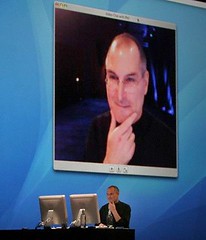
42-16245198When Dan Lyons began writing as Fake Steve Jobs, the online world was intrigued. But the thing that impressed me was the capacity for FSJ to inventively take on the Steve Jobs persona, accentuate some of his characteristics and entertain a growing number of readers. I particularly loved his ability to incorporate news and current events into the commentary, such as this post – Enough is enough! I just fired that idiot Jerry Yang:

But you know what really put me over the top? It was this ridiculous letter to shareholders that Yahoo put out yesterday. Thirteen hundred words long and it felt like thirteen thousand words and in the end what did it say? Blah blah blah friggin blah. Me good, Icahn bad. Jesus, Jerry. That's what you were doing when you were supposed to be blogging? You were writing some lame-ass alibi trying to make up some excuses for your lousy performance? I'm sorry, but you're done. You suck. You're toast. Maybe the Yahoo board can't manage to assemble a pair of balls big enough to fire you, but you know what? I was born with balls that big. In fact I actually like firing people. I get off on it. It gives me wood. You get it? I'm rock hard right now. I'm lifting my desk off the floor. You're done, Jerry.

But did this do any harm to Apple? Did it harm Steve Jobs? The very fact that someone with talent invested the time and creative effort to bring FSJ so vividly to life says much about the passions that are aroused around Apple. And I would argue that the parallel world that was created added dynamism and energy to our perceptions of both Apple and Steve Jobs. In the end, Dan Lyons drew a line in the sand, stepped across it and became Real Dan Lyons.

But what happens when a fake personal brand is a little closer to home?

So now you tell me this internet filter thing isn't going to work huh?Over the past few months, many of the Australians who use Twitter have been treated to the hilarious and sometimes provocative conversations of (fake)Stephen Conroy. As Minister for Broadband, Communications and the Digital Economy in the Australian Government, the real Stephen Conroy drew the ire of many participants in the online and related industries over the proposal for an internet filter/censorship regime, and FSC proved to be a wonderfully satirical take on the events and discussion as they unfolded around this controversial topic.

The characterisation of FSC veered from scheming politician to Internet Geek. Sometimes FSC would mock the participants in the “Twitter echo chamber”, while at other times he would turn his attention to politicians. He even gave an interview to the press earlier this year where, when asked, what activities he pursues after hours, he replied:

I used to be an avid kitten fisherman (purely recreational; catch-and-release), but there just aren't enough hours in the day anymore to find kittens, let alone stuff them into a sack and toss them into a river.

However, as with Fake Steve Jobs, a line has been drawn in the sand for FSC. Over the last few weeks, pressure has been mounting on the person/s behind the caricature to reveal themselves. And today, Telstra employee, Leslie Nassar removed the FSC mask and announced to the world “OK, so here it is; Fake Stephen Conroy = Leslie Nassar”. And this is where it gets interesting.

Telstra is Australia’s largest company and as such is always involved in many large scale projects with the federal government. So the revelation that it was a Telstra employee who had been satirising the government minister responsible for broadband was bound to send Telstra’s PR and corporate communications team into overdrive. Thus far, however, there has been no press release – just this blog post from Mike Hickinbotham which starts:

First off, let's review the facts.
  • Lesile is not going to lose his job as a result of announcing he is the Fake Stephen Conroy
  • Telstra did not shut down Leslie's Twitter account. Fake Stephen Conroy (twitter.com)
  • Telstra did not out Leslie as the Fake Stephen Conroy
  • Telstra's policy is that only selected spokepeople deal with the media

However, Bronwen Clune questions whether this response really is as open and transparent as claimed.

This is certainly a thorny issue for Telstra, and one which many brands will be watching carefully. Particular attention will be paid not just to what Telstra SAYS but what it DOES. As Seth Godin wrote recently on the subject of authenticity:

If it acts like a duck (all the time), it's a duck. Doesn't matter if the duck thinks it's a dog, it's still a duck as far as the rest of us are concerned.

Authenticity, for me, is doing what you promise, not "being who you are".

That's because 'being' is too amorphous and we are notoriously bad at judging that. Internal vision is always blurry. Doing, on the other hand, is an act that can be seen by all.

It strikes me that while many brands seek to reach out and engage their customers in an authentic way, there is still a lot of talking and not enough doing. By Mike Hickinbotham’s own admission, Leslie “understands the whimsical nature of social media and in particular Twitter”. Leslie has been able to build a following and keep a suspicious and cynical audience in hand.

From a branding point of view, this seems to be a great opportunity for Telstra to take advantage of a mini-crisis. I can imagine whole campaigns built around Fake Stephen Conroy or perhaps a more anonymous “Minister for the Internets”. I can see the hundreds if not thousands of tweets, blog posts and articles proclaiming Leslie as Australia’s own @Scobleizer and Telstra the undisputed leader in Australian social media strategy (I’m sure there is the possibility for some post-facto rationalisation by a planner somewhere).

Or, of course, Leslie may find himself out of a job.

A line in the sand has been drawn. Now it is just a question of which way Telstra will jump.

UPDATE: Stephen Collins turns the spotlight around and asks whether we all aren't partly responsible; and "SocioTeque" suggests that today, if any, is the day to join the conversation. Stilgherrian provides another angle over at New Matilda; and Mike Hickinbotham provides an update from the Telstra side of the scrum (apparently Leslie is NOT out of a job).

Who Do You Love, Twitter?

As we move through the various stages of Twitter Commitment, we are eventually faced with the fact that we are now connected to people who we have never met. And as our personal Twitter network grows, we begin to rely on visual identity in order to exercise social judgement.

So, who do you love?

Using Twitter Mosaic I have created a picture of a number of the people with whom I chat with on Twitter. Interestingly, you can use this neat tool to also create coffee cups, T-shirts and even mouse mats – which is the perfect way to bring your online community into the offline world.

Get your twitter mosaic here.

Stop By and Say Hi

marketingmag March is a busy month. I have been writing up my thoughts on social judgement (with the plan to turn it into a book), working as usual on the upcoming launch of a project for my employer – SAP, participating in the ADMA digital technology working group, and talking up the practical side of social media in this month’s Marketing Magazine

But no matter how hectic things get, I am always on the lookout for opportunities to meet new people. Of course, there is always the Friday Coffee Mornings here in Sydney – but this week I will be in and out of Ad-Tech conference. I am even participating in a panel on the Relevance of Twitter. So, if you read this blog and want to meet-up – now you know where to find me! Oh, and I look like my photo!