The Landscape of Influence

Earlier this week I attended a lunchtime seminar hosted by the Insight Exchange. There were some fantastic presentations on the nature of influence from:

Ross Dawson has a great summary of the presentations and the following conversations that freely jumped between audience and panel. Ross also shared his Influence Landscape framework which seeks to visually represent and connect the way that people think, behave and spend. It is a handy visual tool that disassociates the simple causal link between “social media” and “influence” – showing that there is much more at play.

InfluenceLandscape_Betav1

And reinforcing this complexity, Beth Harte has written an excellent post on influence, reminding us that it is not the strong links between people that create movements, but the weak links. This strength of weak ties actually goes a long way to explaining why “viral” marketing is hard to predict. However, it is the work of Duncan Watts and Peter Dodds that shows why marketers may, in fact, be looking in the wrong direction. As I have written previously:

The findings of Mark Granovetter’s research into social networks demonstrated that it is the WEAK ties that lead to action. If this is the case, then influence may only play an important role in the very early stages of branding efforts — to facilitate AWARENESS. But as consumers begin to engage with the brand messaging and various forms of communication, it appears that the power of the social network lies not in the level of influence of any select group but in the susceptibility of the audience to contagion.

Why is this relevant? Because on some level, our role as marketers, strategists or activists is not simply to raise awareness. Our job is to change the way that people think, or act — we want to prompt a change in perception or in behaviour. As marketers then, perhaps our best efforts — and probably our strongest DIGITAL STRATEGY lies in activating the weak links and leaving influence to the mass/traditional media (or to those bloggers who have mass audiences).

It is why we should forget the influential and embrace the curious. And maybe, just maybe, we use Ross’ map to help us surface them.

Strategy Drives Decisions

It is easy to think that once you have set your strategy, that a button is flicked and that the focus switches to execution/implementation. But this is rarely the case. Think about it – if you work in an agency, it is unlikely that your original pitch idea will be completely aligned with the work that is actually released for a client. And if you are client side, chances are that your expectations will transform (and be transformed) as the project is sold-in to your business sponsors and stakeholders. The are always, always, competing priorities – and what may appear to be strategically necessary one day will be out of favour the next. This is frustrating, time consuming and expensive for all involved.

The opportunity, however, is to focus on a flexible approach to strategy – and this means using strategy not as a way of aligning messaging or building a campaign or a brand. It means using strategy to drive decisions.

How does this work?

As you build your continuous digital strategy, it is important to establish a “strategic guiding principle”. This should be a clearly articulated strategic direction that can be applied to any business challenge at any step in the process. It should encapsulate what you do and why and it should be “big picture” enough to apply to apply to the decisions of your executives and granular enough to provide guidance for the rest of your organisation. By way of example, the strategic guiding principle for General Electric was, for years “be number one or number two in any industry, or get out”. Such a principle provides a practical, outcome oriented, but simple framework for strategic decision making that can be used at all levels, from executives determining whether an acquisition should be completed to team leaders planning the skills development of their teams.

Share the Message, Own the Destination

When it comes to digital and social media, I have taken a leaf out of the GE’s book. I often apply a repeatable guiding principle that can be shared with my project sponsors, development and creative teams – share the message, own the destination. This strategic guiding principle is used to help guide the answers to the many questions that arise during a project’s lifecycle. By simply asking whether the choices being made contribute to (or detract from) this strategic principle, we are all able to work autonomously yet achieve a level of coherence throughout the project. It also means we are able to accelerate the process of refining the strategy as we cycle through the components.

And one of the best parts of this approach is that it allows all participants to feel a sense of ownership in the strategy. And by bringing that very human sense of responsibility to your project, you lay the foundations for success.

Continuous Digital Strategy


For the last three years or so I have been writing various articles on branding, strategy, social media and general marketing. And I was thinking that I was contributing to a body of knowledge about HOW to go about the hard work of using digital spaces to change the way that people behave. After all, if there is one thing that we, as marketers strive for, it’s changing behaviour.

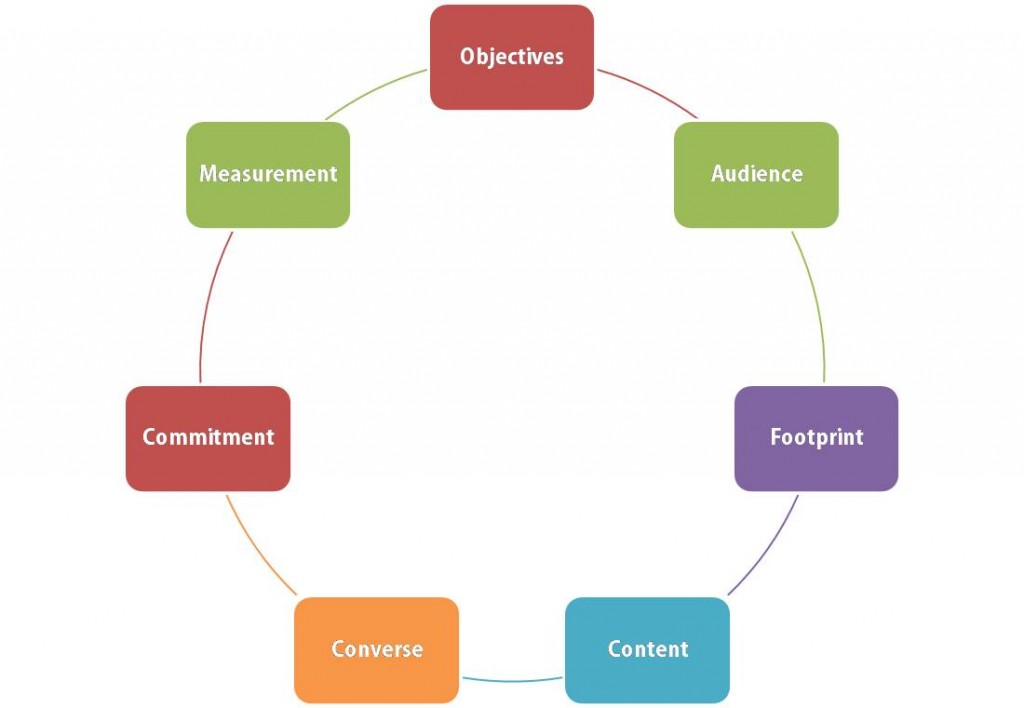
But then, when I looked back through my digital strategy archive, I was surprised that I could not find anything about continuous digital strategy – or the way that I actually go about the business of creating strategy. You see, for me, strategy is an ever-evolving process which is revisted across the lifecycle of any project. So, perhaps it is more of a spiral than a circle as shown above … but really the key point is that each of these steps are to be touched on in rapid iteration in the planning, execution/implementation and evaluation phases of any project. And the faster you cycle through, the more agile and responsive your work will be.

Let’s take a look at how it fits together.

Objectives: You have to have serious objectives. Your insight process will have delivered you a challenge, and out of that you or your client will have laid out some objectives which need to be met. They may be “fluffy” objectives like “awareness” or “reach” or they may be harder – like “increasing sales 20%” or “200 new customers”.

Audience: Once you know what the company or client expects, it’s time to turn your attention to the need states of your audience. What do they want? What do they expect? What do they aspire to? What is unmet? What do they look, smell and taste like? It’s time to get up close and personal with the folks who pay your bills!

Footprint: Now that you know your audiences in their pungent granularity, you now need to understand their behaviour. Where do they go? What do they do? Where to they spend time and why? This is about walking a mile or two in their shoes. But it also a chance to match the footprints of your brands/products. What overlaps? What doesn’t? Where are the opportunities. And where are the touchpoints that will become valuable as your project grows. You need to map out and understand the nuances of these as they will become launchpads for your conversations (or perhaps, as David Armano would say, they are the places where the skimming stones cause a ripple of influence).

Content: As you may have guessed, for me, this is storytime. Here you start to look at the structures of storytelling that will bridge the gaps you have identified in the earlier steps. What can you do to emotionally engage and entertain? How can you use P-L-A-Y to activate, surprise and delight your audiences?

Converse: This is where your strategy becomes one of amplification rather than shouting. In the two-way or polyphonic space of the web, your strategy needs to help you turn great content that YOU produce into great stories that others TELL on your behalf. This is the Auchterlonie Effect that I have discussed in other posts. It is where social capital (or what Tara Hunt calls whuffie) is both created and spent, accumulated and shared.

Commitment: Once we begin conversing – between the people behind the brand and those who consume it, a whole lot of human strangeness steps in. What happens if we like these people “over there” (on either side)? What are the rules of engagement? How do we get serious about progressing our relationship – moving from transactions to experience – and what does that take on both our parts to come to a mutual understanding?

Measurement: We often think that measurement is difficult. It’s not. What is hard is committing to the numbers and to the metrics. If we have done the hard work of aligning our project objectives with the overall strategic objectives of our businesses, then much of this falls in place. But we also need to follow this through each of the other steps. For example, which audiences are important (or are influential) for your brand/product? Measure it. How much time do they spend on the web and on which sites? Measure it. Which pieces of content will drive engagement (and which pieces need to change and evolve as your project grows)? Measure it. How far do your conversations echo across the web? Measure it. What are the intangibles – and what can be substantiated via research? Measure it.

Now, once you have an iteration complete, race through it all again. Pool your learnings from each stopping point and drive them back through the process. Make your brand better. Make your customer experience more profound. Refine, substantiate and evolve.

For me, this is what digital strategy is all about – not the technology – but getting to people. Making it messy. But making it real.

Hey Jude, It’s All About Joy

People who join and sing in choirs get it. People who perform in musicals get it. Bands get it. Record labels (used to) get it. David Armano gets it, as does almost the entire Chinese nation. And perhaps, more importantly, WE get it.

Music, and singing in particular, taps something primal in us. It allows us to transcend the barriers of language and culture. It allows us to see beyond our own prejudices and to become emotionally involved with others. And when we do this en masse, when we sing with a group of others it can be transformative. As Richard Huntington says, “life’s for sharing”.

This is why brands have had a long association with music. It is why finding the “right” song for your campaign is essential – it is a fast-track to engaging with an audience emotionally. Not only that, you draw upon the collective good will (or social capital) of the artists who created the work.

So what happens when you combine all this in a single, large scale public spectacle? What happens when you put the microphone (literally) in the hands of everyday people? And what happens when all of those people start to tell the story of your branded event?

Mortgage Lenders in Freefall?

As interest rates continue to drop here in Australia, many of us struggle to understand how a decrease in official interest rates are not passed on to borrowers in full. And while there are, no doubt, solid, economic reasons and explanations for this state of affairs, consumers tend to disregard such information, relying instead on emotions and “gut reactions”.

Don't PanicThis places financial services brands in an unenviable situation – not passing on rate cuts risks the ire of their customers – while passing on the reductions would further erode margins and shareholder returns. But as with any crisis, there are also opportunities.

I have looked on with dismay as one bank after another clumsily executes a so-called social media strategy. It has been disappointing because social media is, arguably, the most effective way for financial institutions to combat falling levels of consumer trust – if it is done well, that is. By aligning with its customers’ desire paths, banking brands can begin to experience the benefits that come with social judgement. Thus far, financial institutions have shown little understanding of these social processes – but the latest online campaign from the folks at Amnesia are helping Aussie Home Loans take a STEP in the right direction.

Building on the Aussie Guarantee TV campaign where a mortgage broker jumps from a plane in search of a home owner who needs a better deal, the FreeFall Challenge replaces the TV commercial actor with a real, authentic mortgage broker, Duane Brown. So, come April 6, Duane will be strapping on a parachute and a tandem skydiver and taking to the skies. Where will he land? Well, the answer to that question could win you $3000. In a digital form of pin-the-tail-on-the-donkey, you have the chance to mark Duane’s landing site on a Google Map.

Knowing Iain MacDonald’s and Heather Snodgrass' fondness for social objects theory, a digital campaign from Amnesia would not be complete without an in-built object. In this case, you can use codes that have been distributed by social media sites such as Twitter, Facebook, Flickr and blogs to improve your chances of winning the $3000 prize (try using ib2lW2). You can also check out Duane’s YouTube channel.

There is much to like in this campaign, but as Tim Burrowes points out in the comments to this article, this is still deploying social media from a channel point of view – with the entry codes acting as a social object designed to bring cohesion to the whole. However, it is, as Joel Pearson suggests, nice to see some experimentation happening – especially in an industry not known for it. Next time it would be great to see the digital and social media folks involved at a strategic level so that there is a greater level of integration.

You Can’t Touch Twitter

A couple of months ago I was surprised to see a name appear on my Twitter timeline. It was Stephen Fry. He was, in fact, the first celebrity that I would be interested in following.

Then a short time later, another celebrity name started people buzzing. The questions were asked “is @mchammer the REAL MC Hammer”? And as this appearance on Mike Volpe’s Hubspot TV shows, @MCHammer certainly uses Twitter personally – listening, interacting and promoting his new project, DanceJam.

But as Twitter starts to mainstream and the user base grows, it becomes ever more difficult to manage those who you listen to and interact with – which of course, depends on your stage of Twitter Commitment. If you are starting out, you can learn much from Amber Naslund’s excellent guide. But imagine that you are MC Hammer who has about 125,000 followers and is following over 25,000 people in return. How do you cope with the torrent of digital information that streams past you at an astonishing rate? How do you interact, engage or dare I say it, converse? As Cath points out, Twitter is not a gateway drug – you only get out what you put in – and clearly, MC Hammer is deriving value from Twitter not only as a broadcast tool, but as a way of interacting with people. How does he do it and still see value?

I have a much smaller volume of data, links and followers to contend with – and yet it can appear, at first blush, overwhelming. With around 2700 followers, I also follow-back 2300 or so people – this generates thousands of messages each day. To cope with this, I have an iterative strategy – process->tool+process. This is how it works.

Process

As I have mentioned to Iain McDonald previously, I have what Anne Zelenka calls a bursty process. I work very well with the flat knowledge networks afforded by twitter and other online tools at my disposal and have found a way of making discontinuous productivity work in my favour:

We used to talk about two steps forward and three steps back, and so on, but today it’s more like 50 steps sideways and 2000 steps forward. Networked, social-based opportunities are so explosive today than when we pursue them we’re flung forward at pace.

Tool+process

For sometime I have been using TweetDeck. It provides the functionality that Twitter itself does not yet provide. But I use TweetDeck in a particular way.

The far left column contains the messages from all 2300 people that I follow. It refreshes approximately every four minutes; so as you may imagine it flies by at quite a pace.

TweetDeckThe second column is labelled “smart folks”. These are the people that I know and/or whose judgement I trust. These people help filter the twitterstream for me. This column refreshes more slowly.

The third column captures all instances of my twitter handle – servantofchaos. So I see when someone replies to me, or mentions me. It only refreshes every 10-12 minutes.

The fourth column is for direct messages and it refreshes every 15 minutes or so. And additional columns carry particular search terms that are important to my work. They change from time to time, but are an incredibly useful way of monitoring any mention of your product or service.

With my bursty work ethic, I take notice of direct messages as they arrive. This normally works out to be once an hour or so. I quickly also check replies and the smart folks for topics that may be useful or important for me. Once an hour, usually at the top of the hour (or when I need a break from a task), I scan the first column. I look for trending topics and repeated retweets and also scan my search terms. If while scanning I notice that someone asks a question that I can answer, then I do so. Sometimes I retweet a message or respond.

That’s It!

By working in this way, I am able to effectively manage a relatively large network (by my personal standards). I also am able to derive significant value from my interactions with this community. But does this touch what MC Hammer has to deal with? I doubt it. But I hope it helps you @TransformerMan.

How To “Add Value”

I remember a performance review early in my career. I was looking for constructive feedback, wanting to know where I could improve the way that I worked and what particular steps I could take to gain a promotion or better conditions in the following year. But all my manager could respond with was “add value”. And the further I pushed this topic, the more I realised that he really did not know what he was talking about. He was simply reverting to “corporate speak” to avoid giving me a pay rise.

In the world of marketing, there is also a lot of talk about “adding value”. But what does this mean? What are the practical steps that we can take to deliver this "value" to our clients? How do we work as agencies to transform the experiences of consumers? Both Sean Howard and Paul Isakson point out this great presentation by John V Willshire that takes us down the path of creating and delivering value.

What shape does this take? What can we honestly do to transform the work that we as marketers or agencies do.

John’s approach is to look at both the history and future of communities, by understanding the dynamics by which communities come together. The important aspect of this, for me at least, is that the focus is on the co-creation of context – which means that we need to strategically consider context over placement.

But as the focus of this presentation is about how we engage communities – whether they are business communities (which gravitate towards brands or products) or local (geographic) groups and so on. John suggests that there are four clear areas where we should focus our added value efforts:

  • Do something that is useful for people
  • Entertain people
  • Educate people
  • Connect people 

This presentation positions the brand at the very centre of the consumer experience, but Sean suggests that this misses the true opportunity. Rather than pre-empting Sean’s thinking around this, I will wait to see what he comes up with. But I have a feeling that it centres around two things: passion and social judgement. The anticipation is delicious.

For Startups: From Zero to Brand in 48 Hours

The energy around a startup, whether it is technology related or focused on social enterpreneurship, is invigorating. Even a simple question to the founder will elicit a torrent of words about the idea, the business model and how far they are from launch. The passion is palpable and contagious.

But one of the challenges of any new business venture is reaching your audience – and once you have done that, to convert them to ongoing, loyal customers. This is easier said than done. For even the best, most innovative of offers can fall flat without the level of take-up that secures “critical mass”. And this is where marketing comes in (actually, if you are able to manage it, you will have a good marketing person involved in some way very early on).

Peter Corbett has put together this great presentation that leads you through the starting steps of brand building. Sure, you may need a marketing consultant to help you refine elements that you see here, but, clearly Peter’s presentation provides an accelerated framework for branding any new business.


Zero To Brand in 48 Hours from Peter Corbett on Vimeo.

Why the Social Media Edge Will Transform Marketing

Often when I tell people the name of my blog, Servant of Chaos, they take a step back. It seems that the word “chaos” carries with it connotations of danger or disruption. And yet, this is not the case – the “chaos” of which I speak is not anarchy. It is more aligned to chaos theory which is, in reality,  about “finding the underlying order in apparently random data”.

Chaos Theory socks finished!By recognising the patterns within data – whether that data is demographic, technological, individual or corporate – we are able to bring sense to what we see. We can do so, because the interconnected patterns of data provide direction – allowing us to anticipate trends and potential outcomes. And this approach can be applied to understanding changes in individual or group behaviour, society or even global economies undergoing significant change or crisis.

In this fascinating article, How to Bring the Edge to the Core, John Hagel, John Seely Brown and Lang Davison, explain how this works:

We believe there is a sense-making pattern that can help us understand how change takes place in the economy. This pattern is "edge transforms the core."

Applying this thinking to marketing and social media, there are clear parallels. When we look across the marketing landscape, we can see disruption occurring on a number of levels:

  • Content production – user generated content is challenging the might of established publishers for relevance
  • Content filtering – with trust evaporating, populations are exercising social judgement, turning to networks of loosely connected individuals for trust-based decisionmaking (eg purchasing, recommendation, trial etc)
  • Distribution – peer-to-peer, digital and a plethora of user instigated distribution channels have invalidated the modes of distribution that have held sway over the last 50 years
  • Context – our view of the world is increasingly framed and reframed by the networks and communities in which we have invested trust and social capital.

These changes are occurring most profoundly in areas that can be loosely called “social media” – right on the edge of marketing practice. And what we understand instinctively, but are yet to adequately process, is that this social media edge offers a transformative opportunity for brands. Edges really are important:

They represent fertile seedbeds for innovation as unmet needs and unexploited capabilities tend to surface first on the edge. Edges also tend to be filled with people who are risk takers. Edge participants tend to connect more readily with each other because they all confront significant challenges in addressing the growth opportunities. Since there is so much growth potential for everyone, they are more willing to share insights and learning. Edges also have limited inertia since most of the large institutions, installed base and current sources of profitability are in the core.

The opportunity on the edge is, however, what attracts the core. Those established, core brands see the volatile and seemingly chaotic communities building via social networks as marketing’s holy grail. However, not ALL of these edges offer growth – they have uneven potential for growth. What is the difference between a “promising edge and a dead-end fringe” – and how do you tell? Apparently there are tell-tale characteristics:

… significant headroom for performance improvement and a large potential user base. Ideally, they also require modest investment for participation at the outset and offer the prospect of significant short-term returns …

In practical terms, this means that an INTEGRATED strategy is required. It means bringing “the core to the edge” – taking 10-20% of your MEDIA budget and investing it in “edge” activities. It means participating – not just with money, but with time, creativity and enthusiasm (or as Todd Defren suggests – holding an extended block party).

Social media will transform marketing, because we are seeing these shifts now (think of the recent announcements that advertising spend will drop in 2009, but digital/social related investments will rise). We are seeing new ways of producing, filtering, distributing and contextualising content. We are seeing real maturity in practices accelerating from the edge towards the core with the daily emergence of case studies, practical suggestions, innovation and leadership. (And if you are in any doubt, take a look at Todd Defren’s new eBook which goes a long way towards explaining exactly what is social media and how it can be used effectively – all in about 40 pages.)

The emerging patterns are no longer unclear. It is the edges that will deliver the innovation craved by markets – but perhaps most importantly – it may change the very nature of “marketing”. For the edge takes on new meaning:

Not only in their ability to help us recognize new ideas but, perhaps more importantly, in the power they give us to escape the old ones.

The Fail First Strategy

josh seq 3There are many lessons that marketers can “borrow” from the IT industry. “Open source”, for example, has changed the way that many of us conceive of ideas – they are no longer considered the proprietary property of one company/business (or they aren’t in most cases) – after all, ideas are the easy part, execution where it gets difficult. (In fact, we can really wonder whether ideas EVER were owned or whether this was just a convenient illusion.)

Most recently, I have been pondering the concept of “failing fast” –  see the wikipedia entry here. It is a systemic approach to programming that aims to identify and report on failures – or events that are likely to cause failures. The focus of the programmer is on passing the message “FAIL” up to a system that is built to respond. There are two important aspects (that I can see):

  1. The program escalates the issue or failure to another level of responsibility
  2. The program also halts before the failure replicates, spreads or becomes embedded in other systems

From a marketing point of view, there is much to learn from this. And in light of the debacles around Motrim Moms and MyFutureBank more locally, the lessons could and should be absorbed by marketers very quickly:

  1. Listen. As Amber Naslund points out, there are plenty of free tools that can be used to begin monitoring what is being said about your brand, products and services. Start with Google alerts. But please, start.
  2. Step-in. If you are not listening to the online conversations, the echo chamber tends to get louder and louder. As this escalates and draws more voices into the conversation, the absence of an “official voice” means that there is no way to diffuse the conversation. This leads, as Alan Wolk suggests, to overreaction. Once you are at that point, there is no return.
  3. Participate. When you start actually participating you will make mistakes – you may need to slay some sacred cows. But that’s ok … it’s the way we learn. By building relationships you are also creating a community/network. These are the folks who will let you know if someone else it talking about your brand.
  4. Learn. There is much to learn by following the first three steps. Take this information and share it with your product development and customer service teams. Use this to transform what you deliver to your markets and how you treat your customers.

Despite the benefits of the fail-fast approach, however, the brave brand manager may want to take a more tangible, proactive and accelerated path – to FAIL FIRST.

Under a fail first strategy, you already accept that there will be mis-steps. You acknowledge that issues will arise that you won’t be able to control. In fact, the approach means taking a POSITION that people can buy into or work against. It is drawing a line in the sand.

Then, once the controversy starts or the conversation begins, you work them both equally using the same four steps above. Those who like what you are doing will converse. Those who don’t will cause chaos. Engage with both and use them to cross-pollinate ideas. Learn from the nay-sayers how and where you can improve your products. Activate and empower your evangelists to tell their stories.

Now, I don’t advocate such a strategy for all brands. But there are some who could do it. And for those who can stand the heat, there are great benefits to flow from failing first and learning. But remember, you need to PLAN a fail first strategy. You need the systems and fall-back strategies in place that can help you overcome the failure. You need the management support to hold course.

The Motrim debacle could have been turned around. Many similar “crises” could. What would you do differently? Would you dare to fail first? What do you think it takes to create the most successful failure in marketing history?

Reblog this post [with Zemanta]