LinkedIn is B2B’s Gateway to Social Media

While many businesses hesitate to "adopt" social media, many business people are already heavy users of social media sites. Sometimes they don’t even notice it. The ubiquitous success of LinkedIn is proof that even the most reluctant technology user can be enticed into the Web 2.0 space. Clearly LinkedIn have a great value proposition:

  • Allows you to:
    • advertise/demonstrate your professional experience
    • manage your personal and professional network
    • expose this network (and activate its value)
    • identify and facilitate business opportunities in your wider network
  • Provides employers with:
    • easy access to categorised and location based professional profiles
    • ready source of verifiable and referenceable professional histories

And while there are many other reasons to use LinkedIn, the simple fact that many business PEOPLE use it is a great proof point for social media within a business. And for B2B, it just means that you need to clearly articulate the value proposition — how will it impact the business, which problem will it solve and what opportunities will it open up.

Take a look at this interview by Andy Sernovitz featuring David Armano and Matt Dickman — if you listen to your customers, partners and employees then you might be suprised at what you find. But then think about your own LinkedIn profile. Think of its value to you. Then think bigger. Apply that thinking to your business — and I will bet you see the opportunity that social media presents. It’s about the FUTURE of your brand. (I’ll have more on this topic really soon.)

Five Impacts of New Media


  on the press 
  Originally uploaded by Nick Sherman

Looking at new (or social) media, it is easy to see that there are some powerful forces driving change across our cultural, our social and even our political landscapes. These five impacts can be summarised, broadly as:

  • Experts coming under pressure from new voices who are early adopters of new technology
  • New organisations emerging to deal with the social, cultural and political changes
  • There is a struggle to revise the social and legal norms — especially in relation to intellectual property
  • The concepts of identity and community are transformed
  • New forms of language come into being
  • Educators are pressured to prepare their students for the newly emerging world

Now while this seems obvious, pause for a moment. This list comes from Elizabeth Eisenstein on the invention of the printing press, and while it speaks to us in our current state, these changes have actually been underway for hundreds of years.

Why is this important? Because the printing press … and for that matter, blogs, social networks, video and picture sharing tools, conversational and other "Web 2.0" sites are not just tools. They don’t just FACILITATE communication and interaction. They MEDIATE it. The impact of this is profound.

If the way that we understand the world is, in turn, mediated by it, then those brands that do NOT engage with new media are placed at a significant disadvantage. This goes beyond the question of whether your company or brand "should have a website" or a "blog", but whether it is important for you to be part of the web of signification that creates the worlds that we live in.

There is a great shift and a great debate still just beginning (remember, for all the joy and speed that comes with the Internet, we still buy books in record numbers). Can you and your brand afford to ignore these changes? Or worse — will you ignore the chance to engage with and SHAPE the future of media (and therefore our future lives)?

Given the ease with which you CAN engage, it’s not a question of how, but how much. Even dipping your toe in the water is a start. Begin here.

Oh, and if you want to go deeper, check out Michael Wesch’s presentation on Human Futures for Technology and Education. More power to you.

Do You Run with Fast Company?

Fc011995 Years ago I was an avid reader of Fast Company. It contained a wealth of great, innovation and business focused content and featured writers who were pushing both the concept of journalism and the practice of business. Over the years I drift away and come back to Fast Company — perhaps this reflects moves in my career from a focus on corporate innovation across to B2B marketing and on to consumer marketing and life in an agency. But I always find a reason to come back to Fast Company … there is always some value to be unlocked.

And today I find myself returning again … with the announcement of this initiative. Now, anyone can become a member of Fast Company, contributing blog posts, questions and joining discussions. Apparently this will provide you with the chance to have your thoughts and writing sharing the same space as Fast Company writers like Ellen McGirt or Robert Safian or the new additions — Robert Scoble and Shel Israel. Certainly sounds interesting … and I will be keen to see how it actually works and whether this new extended and open network of the "Company of Friends" stimulates debate or whether it falls victim to social networking fatigue.

I, for one, am keen to see it succeed. I have already joined up — and you can too. Hope to see you there!

Cluetrain @ 10: Theses Revised

Webisagreement Late last year I revisited the Cluetrain Manifesto in a post called Why the Cluetrain Still Rings True. I had not realised that we were nearing the anniversary of its 10th year in publication until I noticed that one of the authors of the Cluetrain, Doc Searls, was being joined in a one day conference by Josh Bernhoff (Forrester), Peter Hirshberg (Technorati), Ted Shelton (The Conversation Group), Jake McKee (Ant’s Eye View) and Thor Muller (Get Satisfaction). During his talk, Doc Searls updated some of the 95 Theses (via Josh Bernoff):

1. Advertising as we know it will die.

2. Herding people into walled gardens and guessing about what makes them "social" will seem as absurd as it actually is. (Facebook is his example.)

3. We will realize that the most important producers are what we used to call consumers. (Yup.)

4. The value chain will be replaced by the value constellation. (Many connections.)

5. "What’s your business model?" will no longer be asked of everything. (What’s the business model for your kids?)

6. We will make money by maximizing "because effects". ("Because effects" are what happen when you make more money because of something than with it.) E.g. search and blogging.

8. We will be able to manage vendors at least as well as they manage us. (Agreements between companies and customers shouldn’t be skewed in favor of the companies.) At Harvard Law they call this VRM — vendor relationship management — which is what Searls is working on (projectvrm.org).

10. We’ll marry the live web to the value constellation. (The Live Web isn’t just about stars. Relationships of anybody to anybody.)

As I suggested in this post, the Cluetrain still holds sway over our imaginations because its promises are yet to be achieved. This is not a criticism, but in fact, indicates its visionary nature. Ten years on, the culture, approach and technology of social media now provide us with the desire and mechanisms with which to begin the Cluetrain journey, but the distance to travel is vast and the dangers many. That is why I like Paul Downey’s picture … it shows a cosmology of technologies, ideas and companies. But it is we, the people, who traverse it in microscopic form.

More thoughts to come on this … but what about you? Has the Cluetrain affected you? What is your journey story? Mine tomorrow.

My ooVoo Day? It’s An Age of Conversation, Baby

Snapshot2After participating in one of the My ooVoo Day sessions with my gracious host, Joseph Jaffe, I hung around to have a chat with Greg Verdino. It was pretty funky seeing the sort of live effects that can be used during the video chat … and while it is a novelty, it also add a fun dimension to the technology.

One of the things that I like about ooVoo is the quality. We easily had six participants with video feeds, all speaking and contributing to the conversation. And the idea behind the launch is great — meet some interesting folks, have a chat, use some cool technology and raise some money for a good cause — the Frozen Pea Fund. So, so far, so good.

But then, the indefatigable Drew McLellan came up with another idea. What about if he and I hosted our own chat — on the Age of Conversation? A couple of emails with the Crayon folks later, we were all systems go. So, now, your can sign up for one of 4×15 minute chats with Drew McLellan and myself. What are you waiting for? It doesn’t get much better than this 😉

Oh, and if you want to know what time/date it is in your timezone — try this. We are aiming for 4pm NYC time. That makes it Sunday, 8am in Sydney!

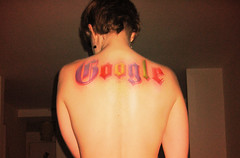
Digitial Natives — Is Your Google Tattoo Showing


Tattoogle
Originally uploaded by lowereastside

Last week I gave a lecture to Dennis Price’s MBA class on social media. It was great fun (for me), and I hope, beneficial for the students. One of the questions that kept coming up was "why do you blog" — or more precisely, what is the value model that drives/informs my blogging.

My standard response is this — blogging provides me with a disciplined approach to creativity, innovation and writing. This blog is a scrapbook of my ideas that I use to map and document my thinking, often returning to an idea months later. This makes my blog, for me at least, a veritable feast of content and concepts — though sometimes the connections between ideas and actions, between strategies and activations are less than clear. Often this is because I am wanting to provoke potential methods of activation, not constrain them.

Often an idea will come upon me unexpectedly. In this situation, I normally login to the blog and type up a one line or one paragraph entry. If there is a link I will include it. Then I publish this as a draft. Later, when I have more time, I return to the draft to think it through and provide some context.

One such draft that I have been meaning to return to is this one. It is on the concept of digital natives, and in particular, on the podcast between two very clever social media thinkers and commentators — Anna Farmery and Paull Young. And while I admit that there are problems with the terms "digital native" and "digital immigrant", they do provide a starting reference to form a conversation as you will notice in Show #136 of Anna’s The Engaging Brand podcast.

I won’t spoil the podcast for you, but there are some excellent points that Paull and Anna make, including:

  • The identity of digital natives is in flux (as it is for all of us in our early 20s) — and as such it is not yet aligned with our profession. This means there is a focus on the way that "work" and "life" co-mingle
  • One of THE most important aspects of job choice is the opportunity to work with friends (or to make friends)
  • This brings a special focus on the alignment of PERSONAL values and BUSINESS values. For businesses wanting to attract and retain digital natives, this touches concepts such as corporate social responsibility, flexible working conditions and accelerated responsibility
  • Digital natives are impatient for outcomes. They are caught between wanting to overcome barriers to action (short term achievement) and achieving longer term beneficial change in the workplace and the world.

There are many other great points raised through the podcast, so it is well worth a listen (or you could simply subscribe to Anna’s iTunes store). Paull mentioned that the digital natives are the first generation to be born with a Google Tattoo (he attributes this to Geoff Livingston). Think about that from a brand point of view. Listen to the podcast. How is understanding that level of commitment going to impact your hiring practices (it should), how will it change your search for talent (it will) and why will this transform the marketplace for your products and services (it already has)?

Remember, if the digital natives have a Google Tattoo showing, then the digital immigrant also displays the marks of their history. How are your markings influencing your future strategies and visions? Perhaps it is time to recast our ideas and approaches.

When a Brand Speaks with a Customers Voice


Erin Esurance
Originally uploaded by scottmw1971

Conversations swirl around the touchpoints of a brand. We mention our favourite brands over lunch, we wear them, carry them and sometimes even drive them. And what makes their study so fascinating and the demands of their stewardship so challenging is that they can and do embed themselves very deep in the human psyche.

In the claiming of a brand, we seek to own, consume and digest some spirit that projects beyond ourselves. And the open identification of our selves with a brand allows others of the "tribe" to spot us in a crowd. The brand marks us out to our kin and kind — fugitives, family and refugees all at once.

And yet even as we begin to take ownership of brands, even as we incorporate branded trademarks and language into our everyday speech, there are many companies who fail to notice our actions. They avoid our incantations, turn away from our devotions and swivel their eyes inwards. Meanwhile our efforts of brand cocophany provide the meaningless backdrop for discussions on typeface, look and feel or customer experience. Surely a moment’s attention is not too much to beg?

Ah yes, but what happens when a brand that you have lovingly crafted takes on a life of its own? What happens when your own efforts at outreach fall flat, while the community’s efforts vastly outstrip your own — in popularity, in style and in AUTHENTICITY? What happens when your brand voice sounds better coming through the mouths of your customers?

I only ask because of this discussion started by Chris Kieff around Erin Esurance. Chris nicely documents a series of brand eruptions that have broken out across the social media landscape and charts their effectiveness. It is clear that the work of fans resonates more strongly than efforts of the company and its agency.

So what is one to do? Chris has some good answers. What are yours?

Time to Chat? MyOovooDay is for You

Oovoologo "Getting" social media is difficult. It is a participatory format … and that means that you have to get involved. You have to try things. Install things. Sign up and register. If you are like me, that means that your computer is littered with half forgotten applications that were of use or interesting once. And my web browser is worse — the toolbar is littered with active or half hidden items that capture data, make it "easy" to search, rate sites or track my viewing habits. But there are things that stick. Sites that work. Places that become part of my own personal web. Applications that I turn on and leave on.

My buddies Scott Monty and Greg Verdino have been subtly spruiking the merits of their client, ooVoo for a while now. But it is all stepping up a notch with the launch of MyOovooDay. This initiative is pretty neat — sure you need to download and install the ooVoo client — but there is more. During MyooVooDay (which actually lasts for a little over a week — February, 10-21), you can sign up for a conversation with some of the social media scenes leading lights. You can choose to chat with any (or all) or the following:

And if that was not enough of an incentive to test out the capabilities of ooVoo’s video chat/recording features, ooVoo have also come to the party — donating $1500 per session to the Frozen Pea Fund (the fund established to support the American Cancer Society’s "Making Strides Against Breast Cancer" campaign, in honor of blogger and cancer patient Susan Reynolds). So not only can you chat with some super-bright folks and play with some cool technology — you can also help do some good:

  1. Choose who you want to talk to
  2. Download the software
  3. Sign up for a session

For those of us outside of the US, the times may not work so easily. To make things a little easier to schedule, take a look here and see which times cross-over for you. I plan on talking with Mr Conversation, Joseph Jaffe on February 11 at 8pm (which is midday on Tuesday here in Australia) … and I would love for you to join in! I am keen to see if ooVoo is a keeper or a sleeper 😉

How to Look Great in Photos

Now if you are like me, you are bound to have suitcases full of bad photos of yourself. If so, take a look at the following video to learn how professionals reduce the chance of a bad shot.

I was asked recently what would Web 3.0 look like? And not that I make predictions or am really close enough to the emerging technology side of things, but it seems to me that the innovations that we are likely to see are grouped around the "micro". Think micro-charities. Micro-communities. The niches of niches. The Web 3.0 innovations, in my view, will make Web 2.0 useful.

Hence this post on "looking great in photos". While this is useful information (and to be honest, I need all the help I can get), really what I want to draw your attention to is the launch of Howcast (via Techcrunch). This is a new venture from some some ex-Google folks (Jason Liebman, Daniel Blackman and Sanjay Raman) — with a focus on instructional content. There are wikis as well as videos. It will be interesting to see how the quality of user generated content goes. Now, all I need is a crash course on the Photoshop Healing Brush and I will be set!