No Clean Feed – Internet Censorship in Australia

CKnocleanfeed If you use Twitter, you may have noticed a bunch of people are using avatars with an X across their mouths. This is a protest against the Australian Government’s plans to implement an internet content filter. This plan places a blanket of censorship across the internet which will, no doubt, have unforeseen consequences – and puts our access to information on a par with China and Iran. (My friend CK, pictured, has joined in, and I would encourage others to do the same.)

For example, when travelling in China I found that I was unable to access my blog. It is not like I write dissenting material. I put it down, in the end, to the title of the blog – Servant of Chaos. It seems China does not approve of chaos. And I am concerned that this “new Australia” may follow suit.

Furthermore, once internet filtering is in place, what safeguards will we have over excessive filtering? What rights of recourse will we have to follow to have our websites “white listed”? And how much will this cost? Is this perhaps a veiled attempt to “control the conversation” emanating from a growing and more vocal constituency via blogs and social media?

While this may be alarmist, remember, we are now just emerging from a time where political debate was managed according to “core” and “non-core” promises. It is disappointing to think that some of the first digital steps of a new government are those being contemplated by Stephen Conroy. It is frightening to consider where this may lead, or more importantly, what impact it will have on our nation’s innovation and place in a global knowledge economy.

There are more details on The Australian’s website where I left the following comment:

So our government is aiming to spend more than $40 million dollars of taxpayer money on technology which can be circumvented and does not achieve their stated aims?    
Why not invest this money in the FUTURE of our country? Put it into the ailing education systems and teach our kids how to safely use the Internet. Or use it to bulk purchase the XO Laptop — which would deliver 200,000 computers into the hands of kids who cannot afford them.      
As the saying goes, give a man a fish and his hunger will be satisfied (for now). Teach him to fish and he will feed his community.      
We have just had 12 years of feeding. It is time to fish.

Update: Get Shouty’s "future husband" (wouldn’t they make a lovely couple if they had met) Angry Aussie gives us the lowdown on why this is a bad idea and why it won’t work.


Reblog this post [with Zemanta]

Off the List


  Meine Eltern – my parents – Retrophotos 
  Originally uploaded by Ela2007

Whenever a new "list" comes out, we all scramble to see it. We want to know who is ON and who is OFF. We want to know who we know and who we SHOULD know. In short, we want to know where we BELONG.
When Mack Collier kicked off the Z-list a while back, it was done in part, as an attack on Technorati and the way that they measure "authority". Yet, while we can rebel about lists and argue about the metrics that they use, they do serve a fundamental function — they help us categorise and contextualise our place in the world. And if we are NOT on a particular list, our aspiration to belong marks us out as a participant in that community.
Guy Kawasaki shares what he calls the "mother" and "father" of all social media lists. Now, go check them out and tell me … did you look for your own name first or the names of those you know.

Reblog this post [with Zemanta]

Join the Solution Stars Video Conference

FiguresEvery year of my working life, technology has transformed the jobs that I do and the way that I perform in those roles. From my earliest start in an chartered accountant’s office where I began using Lotus 1-2-3 and the Basic programming language to automate my more mundane tasks, I have always focused my use of technology towards a business outcome.

These days, technology is second nature to me. Each day I use a web/tele-conference facility of some kind to collaborate with colleagues around the world; listen and scan online conversations for products and services that I am responsible for; download podcasts and vodcasts; read and respond to blogs, Facebook group discussions and forums; and a number of other things. And while I live in Australia, I am now more globally connected than I ever have been.

As the twin pressures of climate change and financial chaos continue to reverberate through the business community, we will need to increasingly use these types of technologies to cost- and time-effectively deliver value to our businesses. After all, it is not that the business need for global collaboration has evaporated – just the conviction (and funds) that we need to do so face-to-face.

solstars_badge_square From a brand point of view, the timing has never been better, nor the environment more open, to begin experimenting with social media. Sure, there are pitfalls; but you can learn a great deal simply by beginning to participate. You could start by joining the Network Solutions Solutions Stars Video Conference on October 29. By my calculations, the 1pm New York start time translates to 4am Sydney time and 5pm GMT.

This free video conference aims to provide insights and online marketing tips to small businesses … but the advice can easily be applied to larger businesses and brands. The conference features nine different documentary style video sessions:


  • Building Web Presence
  •  

  • The Social Opportunity
  •  

  • Start with Listening
  •  

  • Strategy Drives Outreach
  •  

  • You Need Social Networks
  •  

  • To Blog or Not to Blog
  •  

  • Visibility Through Search
  •  

  • Rising Above the Noise
  •  

  • Time Demands

A great cast of speakers have been assembled, including:

And while it may be an early start for some of us … it’s a small price to pay for some great advice from those who not only talk about marketing, branding and strategy in a socially connected world, they practice it daily.

Shall we agree to meet there online? I’ll bring the coffee!

Reblog this post [with Zemanta]

The Arrival of iMalcolm*

This week there has been much debate around the notion of digital identity. After all, just because someone owns a “username” or email address, it doesn’t mean that their identity can be assured.

Stephen Fry, a self-confessed gadget lover, is well known as a blogger, but his sudden appearance on Twitter saw a gold rush of a kind – with the digital network humming as word spread of his bonafide participation in the digital conversation. I am sure that I am not alone in thinking of printing and framing the confirmation email announcing my new connection to a very real celebrity. The important aspect of this, was not only how quickly it spread (after only days he is following around 5,500 people and has an almost equal number of followers), but that in the act of spreading there was an implicit validation – Stephen’s identity was confirmed by the community who propagated his participation. This has since been followed up by clever tweets that intertwine his personal, professional and geographic narrative.

stephenFry


Contrast this with the misguided attempt by National Australia Bank employees to generate conversation about their fledgling uBank MyFutureBank.org online service. This probably would never have garnered much attention if NAB had not already weathered one social media storm. However, in an environment where social currency is dependent upon reputation and trust vests not in the brand but in the community you serve – a second opaque excursion into the blogosphere was always going to prompt a response. Both Stephen Collins and Laurel Papworth responded, “sniffing out” the fake identity and wondering where, exactly, NAB sources its social media strategy expertise. Clearly NAB did not anticipate or even understand the viral and contagious nature of online conversation … and the way in which TRUST permeates and underwrites all our interactions.

UPDATE: Charis Palmer over at the Better Banking blog confirms that MyFutureBank.org has been PULLED and brings another viewpoint to the table. I have left a comment, but would love to hear your view as well.

iMalcolm So it was with some trepidation and mis-trust that the Twittersphere greeted the arrival of Malcolm Turnbull, Leader of the Federal Opposition (Twitter ID: @turnbullmalcolm). It was doubly confusing because we were also suddenly confronted with @malcolmturnbull (whose Twitter bio states “i is teh leaderz”).

In the first day, iMalcolm gathered a great deal of followers as the interest and contagion set in. He was, however, beyond frugal in the number of people he would, in turn, follow (day 1 score iMalcolm 443 vs the population 0). But around mid-afternoon today a change occurred, and iMalcolm began following those who had followed him. This reciprocation hit like a shockwave across the Australian Twittersphere. In response to a direct question (“can you please confirm …”) from John Johnston, the reply came: “@jjprojects it is me myself and as you can see I am still learning how it works. Cheers, Malcolm.”

While politicians in the US have welcomed the opportunities to reach, engage and activate the constituencies, it has been slow going here in Australia. In fact, the innovative approach that the Obama campaign have developed, I would argue, outstrips any efforts that have come thus far from brands or corporations. Perhaps iMalcolm has seen this potential. He has already taken on the lessons freely offered by the Twittersphere, and has a substantial web presence as you would expect. Interestingly, this extends to include a quirky (and humanising) dog blog. While iMalcolm has clearly arrived, I have a feeling we will be hearing a whole lot more from him – and don’t expect him to be disappearing any time soon. (Unlike some online bank.) 

And this, just in, from Julian Cole who has already found iMalcolm hitting the Twitter back channel during question time.


*iMalcolm – a real person tweeting in the name of another. From time to time, these identities will actually coincide with reality. Not guaranteed.

Reblog this post [with Zemanta]

Do Good on Blog Action Day

Are you new to social media? Does it feel confusing? Fast? Alien?

When you step into the social media world, you certainly are entering a new domain and a new way of understanding the way that we PARTICIPATE in our local and global communities. I don’t mean the veiled participation of global democracies. I mean, real me-and-you participation … working together to CHANGE what already is into something we WANT it to be.

This is a fundamental change in the role of the individual. It is tribal, but tribal by association. We can choose where we belong. We can mark ourselves as participants simply by doing … and indeed, one of the hallmarks of social media is the collapsing of thought and action. In this brave new world, words (while powerful) fade in comparison to actions. Our measurement, our worth, our standing in the world is determined not by what we write, but by what we do. And Blog Action Day is a great example.

October 15 is Blog Action Day, a non-profit event that aims for mass participation around a single theme. This year, the focus is on poverty and there is much that you can do to raise awareness and contribute to this global movement: 

  • You can make a loan and change a life by investing in an entrepreneur’s business through Kiva   
  • Visit BlogActionDay.org, register and contribute to the movement by writing a blog post
  • Read other Blog Action Day posts, comment on them and help build momentum

But if you are closer to Sydney and you want to make a tangible difference to the lives of others, consider attending the Article Thirty-Nine Concert in Sydney next month. Tickets are now available, and there are some great bands donating their time and talent in support of child soldiers.


Reblog this post [with Zemanta]

A Big Week in Australian Business Blogging


  A big turnout 
  Originally uploaded by servantofchaos

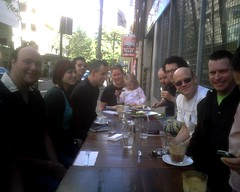
For those of us who are involved in blogging (or broader social media) from a business or professional perspective (here some of us are enjoying a Friday morning coffee at Single Origin), it has been surprising and not a little frustrating to find Australian brands and businesses actively resisting the opportunities presented by social media. For while social media tends to have an aura of "danger" for brands or can be considered to be the personal diarizing of the great unwashed masses, smart marketers are reaching out to their customers directly and with great effect. And perhaps, this week will see a change in the social media landscape here in Australia.

For a start, we are seeing the flow-on effects from the global financial crisis, with businesses indicating that their advertising spend is likely to drop. This will mean even greater scrutiny over marketing budgets and promotional efforts in the year ahead (or as I suggested recently, it’s not time to cut through, but to cut out). This bodes well for social media based efforts where long term brand engagement, trust, preference and recall are staples.

It seems that this sentiment is being echoed in the wider business community — with both B&T and Smart Company giving some serious prominence to blogging. B&T not only announced a redesign of their website, but followed through with a revamp of their magazine where they feature an update on Julian Cole’s list of the Top 50 Australian Marketing Blogs. Not only do they list the Top 50 (where I am proud to be included at #2), they also devote space to an interview with Katie Chatfield and David Gillespie. This represents, in my view at least, a significant change in the attitude of one of the local advertising industry’s leading publications. I look forward to seeing whether we can move towards the sort of roundtable discussions we had with AdAge in New York earlier this year.

Similarly, SmartCompany have a great article on business blogging. Brad Howarth interviews Steven Noble, Jeremy Mitchell and Trevor Young who discuss:

  • Small business blogging
  • Getting started with blogging
  • Five tips on content

The article is wrapped up with a list of 15 of Australia’s best business blogs. There are some excellent blogs listed (even a couple are new to me), but all worth checking out:


It’s Not Time to Cut Through But to Cut Out

As I have grown older, I have been amazed to realise that the more I know, the greater is my capacity to learn. Not only can I quickly absorb new information and transform it into knowledge, I can also direct this towards business and branding opportunities. Even where I come in contact with some completely foreign information, my brain scrambles to find a connection that allows me to contextualise it.

But what about you? Do you find that your capacity has increased over time?

Angela Maiers provides a great explanation in this 30 minute class. She leads us through the different types of connections that we can make so that our memories can be stimulated:   

  • Easy – the simple connection can be made because of our exposure to a topic. There is no work involved here. A common topic will add a new layer over the knowledge schema that we already possess – and the information will be readily accessible to you in an instant.
  •    

  • Dig – while a piece of information may not have an instantly recognisable hook on which you can make a connection, a small amount of digging into your own knowledge will help you. This will require some effort, but will also help turn a piece of new information into actionable knowledge.
  •    

  • Impossible – when we are introduced to an alien concept, we are faced with an impossible situation. There are no EASY ways to make sense of the information. Digging provides no context and no prism for understanding. When faced with the impossible piece of information, our natural instinct is to begin to memorise, to rote learn – but this is a mistake, for without providing some personal context to this information you will not be able to retain and apply this knowledge. It will gradually fade from memory.

In the last 10 minutes of this video, Angela shares an approach that allows us to begin creating NEW memories. She explains the technique for creating the first thread of retained knowledge upon which you can build additional context.   


  • Chunking: After reading/absorbing a piece of information, the main ideas are categorised by the ideas that they invoke. This is not about collecting facts. It is about finding one or two words that connect and explain the overall concepts.
  • Joining the dots: Once you have the “big ideas” you then need to make connections between them. You need to write them down. You need to establish a narrative between them.

Now, think about this from a branding and marketing perspective. Have you ever wondered why some things stick and some don’t? In general, the information that comes to us through advertising is “impossible”. We are hit by facts and assaulted by images. These all seek to CONVINCE us.

However, if we are each subjected to 5000 marketing messages per day, the blink of an eye that acknowledges each new message will instantly erase the previous one. This means that those marketing messages that are mediated, that come with BUILT-IN context, are more likely to anchor in our memory (hence the use of popular music/spokespersons) – and this plays particularly strongly for digital/social media.

And in a time of increasing financial uncertainty, brands will be looking not to CUT THROUGH but to CUT OUT. It won’t be a matter of your brand standing out in a crowd, but of eeking out some space in which it can create meaningful context in which your consumers can participate. Those brands who have begun experimenting with social media will have an advantage in these tougher times; and those who have not will need to accelerate their engagement by hiring agencies and consultants who have a deep understanding of hands-on brand activation in the digital/social media space.

Interesting times? Sure … but really, as Angela Maiers says, it’s about making connections.

How to Thrive in a Slow Down

DSC04560I can remember watching the Twitterstream a couple of weeks ago as the global financial crisis deepened. Here in Australia, we sit on a strange timezone precipice, where as our Monday ends, it is just beginning in the US … and a small band of locals would stay up late just to watch the first few minutes of trade in New York. There is an odd sense that we are, in some small way, witnessing history in the making.

But while the macro story is being played out thousands of kilometres from my computer screen, the impact has yet to really hit. However, there are some things that businesses can do to begin focusing their marketing efforts right now, before the shockwaves seep into our businesses. John Rosen has an excellent and detailed post that advises an initial three steps:

1. Be clear about your strategic objectives. Understand the financial measures that you are focusing on, determine the most important long term relationships, maintain your product/experience viability and figure out which competitors you should attack directly.

2. Understand your brand from a competitive point of view. Look at where the value rests in both the competitive and non-competitive environments; and do the same from a premium brand offering perspective.

3. Re-evaluate and adjust your marketing. While this sounds obvious, check out John’s list of “Do’s and Don’ts”

Craig Wilson, however, suggests that we may well be at a turning point for both the types of marketing that we do and the agencies that we use to plan, create and execute. In this great, and far reaching post, Craig outlines the state of affairs, the issues at play and makes some suggestions for where we might be heading.

Social media may well be rising at the perfect time. As consumers grow increasingly weary of broadcast advertising, and have more control than ever over the media and content they wish to consume, social media offers a subtle new direction for marketers to build relationships and brand.

The social media revolution that we have been asking for, may well materialise more quickly than even Julian Cole would have anticipated. Not only do a variety of indicators suggest that digital and social media related marketing will increase (taken in large part from the traditional marketing budget), the economic circumstances will sharpen the focus of all marketers – ensuring that campaigns and promotions receive ever greater scrutiny. And with a bevy of measurement tools at hand, digital analytics are likely to become very popular on both client and agency sides.

So, how do we thrive in this slow down? Adapting to change … evolution … new thinking and innovation, of course. Think change management and business consulting mixed in with marketing. Think the end of your agency as you know it.

But don’t rush … take it in, for as Craig says:

We may really be at one of those unique times in history, a turning point that forces change and massive innovation. New economic realities will necessitate reinvention for old media and marketing businesses to stay relevant, and will result in the rise of new media options and new marketing thinkers.

Look around you, at the media landscape today, the agencies that feed them and the marketers whoa re their clients. Take it all in. Make a mental snapshot. It may be the last time it ever looks like this.

Telstra and the Sacred Cows

I remember when Telstra’s Now We Are Talking blog launched. It made a bit of a ripple, but did not really dint my consciousness, which is surprising because I am always on the lookout for brands (especially big brands) who are digging into social media. But what I do recall was a brief visit to the site and a feeling that this “blog” was going to be just what the name suggested – a whole lot of talking and not a lot of listening.

Last week, Mike Hickinbotham (from said blog), tagged me to give my two cents on whether nowwearetaking is hitting the mark. It was a nice tactic as the previous week we had a short Twitter conversation on the topic of Gartner’s hype cycle (and yes, I am still working on a post about that) … so Twitter was used effectively to reach out and break the ice, and then the blog activated to extend and deepen the engagement and conversation. “The old one-two”, as Maxwell Smart might have said.

But for me, the old one-two in social media is about the exchange of value. It is about the easy fostering of conversation and the swift conversion of that dialogue into action. In many ways, it’s more about doing than talking, after all, actions speak louder than words. And now, at least thanks to Mike, I was curious – and wanted to see just how Australia’s largest corporate blogger was dipping into the big pond.

When I visited the site, I thought I might comment on Mike’s post. Then I noticed that before being ABLE to comment I needed to register. But this is no simple registration process … I needed to also provide my postcode as a form of identification along with some demographic data. Within seconds, I have TWO barriers in place before I can even begin to have a conversation.

Recommendation: Open up comments. Make sure that a valid email address is provided, but registration is an inhibitor to conversation (which is supposedly one of your aims).

As I stepped through the registration process, I was greeted by a link to the Terms and Conditions. And while I knew what awaited me, I just couldn’t help looking for it:

By submitting material to a Forum, you: 

  1. grant us a perpetual, royalty-free, non-exclusive, irrevocable worldwide licence to use, copy, publish, publicly perform, communicate and adapt that material, and to sublicense those rights through the operation of the this site; and 
  2. agree to its public disclosure.

So not only do I have to register my details, I also have to sign over the rights to any insight I share as part of a discussion!

OK, to be honest, this does not really bother me. It is, however, an indication of the lack of “transparency” despite what seems to be good intentions on the part of the bloggers.

Recommendation: Go crazy and republish your blogs under a creative commons license. This will not only demonstrate that you GET social media and its economy of mutual attribution and participative value co-creation, it will also build you enormous and instant goodwill.

Wrap-up

Now, I am no stranger to corporate bureaucracies, to legal reviews or brand guidelines; so I have to tip my hat to Telstra’s social media team for making it this far. But, to be honest, as Cameron Reilly suggested, there is a long way to go.

There are a growing band of active Australian bloggers who also provide consulting services, strategic advice and insight as to how you can plan for, build and execute an integrated strategy with social media, trust and transparency at its heart. I am sure they would help accelerate your successes in this space (especially now that you are throwing Twitter into the mix). It’s time to slay some (corporate) sacred cows and really get the message out. Telstra has made a great start but is also faced with an almost unmatched opportunity. I’d like to see them take it.

Update: The conversation continues with Lid providing a series of tips and insights; Stephen Collins suggesting a thorough reading of the Cluetrain Manifesto and the Zappos tweetstream; and Katie Harris giving the thumbs down. Jye Smith has also chimed in.

Reblog this post [with Zemanta]