Australian Consumer Online Experience: Earned Media Wins

Right about now, most marketers will be starting to set their budgets for next year. We are looking at what worked this year, what didn’t, and thinking about how we can capitalise on the positive momentum and new product/feature launches that are planned for 2010. For some this means buying media. For others it means looking at earned media.

One of the very first things I do is to look at where my customers are playing. And by “playing”, I mean, where do they spend their time. How do they break down their days? I am looking for an understanding of their BEHAVIOUR. I am looking for opportunities to ENGAGE, not chances to interrupt. I’m seeking participation.

For me, it starts with data. I feed this into my continuous digital strategy process (regardless of whether it is digital or not). I look at the Google Trends data and I cross pollinate it with my own web analytics information. What do I see? I see the phenomenon that Ian Lyons is seeing. On the Datalicious blog, Ian suggests that Australian Brand Sites are Losing to the Social Web:

    1. We are hanging out in social sites where relevant content finds us through our friends rather than searching out brands
    2. Content is being pushed off-site through mechanisms such as RSS Feeds, Twitter, YouTube Channels and Facebook Fan pages
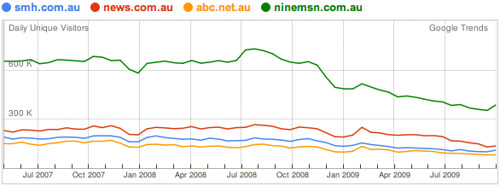
Google Trends for Australian Media Properties

Ian shares a number of graphs to to demonstrate (take a good look at the post for more), but this one above clearly shows a significant fall in the number of daily unique visitors to all Australian online media properties. The most dramatic fall belongs to NineMSN.com.au. The important thing to remember with this, is that consumers haven’t suddenly lost half of their time or attention – they are shifting attention (their precious resource) to other places. And clearly consumer behaviour is not shifting to brands or even brand websites – it’s shifting to our friends, connections and family – online.
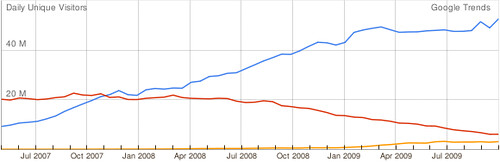
Google Trends for SNS

Facebook is the big winner. It’s winning because the future of your brand is social. It is winning because the decisions we make are now social. And as consumer behaviour and action continues to shift, as people continue to rely on social judgement as a means of filtering the thousands of advertising and branded messages they encounter each day, brands are going to struggle to remain relevant or even interesting.

It’s time to think about what I call the Auchterlonie Effect. It’s time, as Ian suggests, for brands to think of themselves as (niche) publishers. And it’s time to think about shifting that media budget of yours away from SPENDING and into INVESTMENT. Remember, on the web, content lasts forever. Use that insight to your advantage!

Want My Copy of Trust Agents?

Trust.When I started reading Chris Brogan and Julien Smith’s book, Trust Agents: Using the Web to Build Influence, Improve Reputation, and Earn Trust , I planned to jot notes, tweet summaries and scribble in the margins. But I must admit that I did none of these things. You see, these two write so engagingly that once you are IN the book, you forget about everything else. Normally this only happens to me with novels, but there are some great storytelling elements in Trust Agents – and with every chapter my mind was whirring – in agreement or thinking through how an idea could be put into action.

What I liked about this book is that it focuses on YOU – the person who participates in the world of social networks. It shows you how to begin to build profitable relationships with these “trust agents” – “digitally savvy people who use the Web to humanize businesses using transparency, honesty and genuine relationships”. It also shows you how you too, can become a trust agent.

One of the suggestions in the last chapter was to give your book away. Now, I love collecting books, but I like this idea. There is a great deal of value in this book for anyone interested in the online space. So, while I would encourage you to BUY a copy of the book – you have a small chance to get a copy FREE. It’s in excellent condition – no margin notes, no marks – and it smells like new. If you want it, leave me a comment telling me why YOU should be trusted with this book. You only have until the end of the week.

Oh, and I will mail it to you anywhere in the world.

So tell me, should you be trusted?

Branding is a Marathon

Running BunnyOne of the greatest, and perhaps hardest to quantify, benefits of social media is in the area of branding. But then again, this is nothing new. Trying to quantify the value of your brand is exceptionally difficult – just ask yourself how many businesses actually have their brands’ value represented as line items on a balance sheet?

One of the crowning achievements of the marketing industry over the last 50 years or so is the general acceptance of the value of branding. For despite the slipperiness of brand “valuations”, businesses AND consumers clearly “get” brands and branding. On the business side, solid and established brands provide a ready platform for our demand generation and other marketing activities. And as consumers, we are more than ready to mould our lifestyles around those rare brands that we have come to love – indeed, in some instances brands are intrinsically linked to the way that we create our identities (just think, for example, of the tribes of car fans).

Yet despite branding’s elusive nature, a well planned and executed, continuous digital strategy can create a very real, very tangible brand platform. And this is where social media presents a powerful opportunity. As you begin to execute on your strategy, you create multiple points of conversation across your business ecosystem – what can best be called your “digital footprint”. The more points of interaction that occur across your ecosystem create points of connection and exchanges of value. And as these are personal networks (not broadcast), there is a weighting – with one-to-one relationships the exchange involves trust and reputation. This is FAT VALUE.

And the more Fat Value that is created in an ecosystem, the faster GRAVITY begins to take shape. So every piece of content that you create, every link that you share and every idea that you set loose allows someone else to benefit from their interaction with your brand. And in this exchange of benefit, you are fulfilling your brand promise and creating branded experiences. And if you have your strategy right – this gravity will eventually begin to pull participants towards your brand.

This sounds great in theory, but making gravity takes a great deal of effort. In fact, branding in the social media space is more like a marathon than a sprint – hence the need to beware of those selling or offering quick viral wins. As Amy Mengel suggests, while the lure and attractiveness of a quick, viral hit is great for the adrenaline, the subsequent fall from attention is usually just as fast:

Despite the excitement it generates for a few days, the video your brand launched that “went viral” on YouTube may be entirely forgotten in a few months or weeks and ultimately do nothing for long-term growth.

A great example is Skittles. Remember Skittles.com? For a day or two – maybe even a week, Skittles.com was hotly reported across the web. Blogs were alight with idea that a brand would reflect not itself, but the consumers who were talking about the brand and their products. They did this by featuring their Wikipedia page, Twitter stream or Facebook group. David Berkowitz explained:

Here’s the message Skittles is sending: What consumers say about the brand is more important than what the brand has to say to consumers.

skittleschart

But where do brands go after the high? Freddie Laker at Ad Age wondered what would happen next, and this chart from Google Trends seems to indicate that this great experiment went nowhere. Then again, the Facebook fan page boasts 3.5 million members. It makes me think that FAT VALUE – those brand exchanges that take place between PEOPLE networks happens in places that even Google can’t adequately penetrate.

Now that is a fascinating thought.

Paid or Earned Media – Making Gravity is Hard Work

Whether you are walking down the street, watching the TV, surfing the net or even driving a car, you are the subject of some form of advertising. From the branded cap on the boy walking down the street to the billboard behind him – marketing is hard at work trying to capture your attention. Constance Hill and Bruce Henry suggest that we see around 3000 marketing messages each day. But no matter whether we see 100 or 10,000 messages – clearly we are exposed to a significant number. But how many do you recall? How many seep into your unconscious, adding a negative or positive neuron to your thoughts around these brands?

Now, add into this mix the dozens or even hundreds of blogs that you read and the tweets that you view on Twitter each day. Combine this with podcasts, music streams via blip.fm, videos on YouTube and email – and suddenly you have an abundant media stream that can appear overwhelming. As Sean Howard says, “In today's world everyone is a publisher, everyone has some level of influence, and everyone has a network of influence that is difficult to define let alone measure”. It makes the life of the media consumer rather complex.

As a marketer, however, you do have a specific objective. What you are aiming for is MAKING GRAVITY. With paid media you are using your marketing budget to have your content inserted into spaces that your audience inhabit. It is an expense which you measure in terms of how many people you have reached with your communication.

Earned media (or what Craig Wilson calls engagement marketing), on the other hand, is both different in nature and in measurement. Rather than being an expense, it is an investment. Its effectiveness is directly related to what you DO rather than what you SAY, and the value that is exchanged is not currency, but trust. As I have explained previously – it is about changing behaviours:

Every time we forward on a link, retweet a message read on Twitter or any other type of social network interaction, we are CHOOSING to act. We are not just using our network of connections to FILTER the noise, we are using it to SHAPE our experience. It is a choice. And understanding this distinction places us in a context where STORYTELLING emerges as vitally important?

Paid media has been an effective marketing approach for hundreds of years (if not longer). But it thrived in a time where attention was abundant and our media consumption choices were limited to a set number of channels. These days, media is abundant but our attention (and maybe more importantly, our respect) is scarce. Graham Brown has an excellent five minute piece on the challenges presented by these changes.

But the fundamental difference with paid vs earned media is the refocusing of effort. No longer do you spend your creative energies (and budgets) on producing executions that gain attention – you spend it on building trust and creating Auchterlonie Effects (stories that can be easily shared). Indeed, in the best traditions of storytelling, earned media propagates itself – becoming promiscuous in the process.

The reason that promiscuous ideas are important to your brand is that you WANT them to be shared. In social media, every shared idea, link or concept creates an exchange of value within a PERSONAL network – so the act of sharing is a recommendation of sorts. Over time the person who “adds value” to their network builds an abundant store of social capital. It is like branding – we can’t necessarily point to a PARTICULAR item – but to the recurring and ongoing sense of positive exchange relating to that person.

When YOUR brand story or content is the subject of that exchange, you are effectively providing a reason for connection between people in a network. And as these connections grow, as they are passed from person to person, you are creating points of gravity around your brand ecosystem. Your challenge then is to work with a continuous digital strategy to “share the message” but “own the destination”. The thing is, gravity can only be earned. And while you can employ paid media to complement your earned media – you need to make sure you have a compelling story to tell and to share.

See Me Speak at the MarketingNow Conference

Some organisations are beginning to experiment with social media, while others feel that they are well advanced in their efforts. But if you are like me, you will know that there is always something new to learn or a new approach to consider.

Gavin Heaton speaking at MarketingNow! Conference in Melbourne So, in a couple of weeks, there is a fantastic opportunity to hear from some leading social media practitioners. The MarketingNow! Conference in Melbourne is presenting two days of intensive training and interactive workshops with:

  • David Armano: Talking on “social media for social good” and “social business design” (you’re going to hear a whole lot more on this). It is a real coup to have David speaking here in Australia and a rare opportunity for local marketing, advertising and planning folk to see him and his well-known visualisations up close.
  • Darren Rowse: Probably the most prominent blogger in the country, Darren will be leading a Blogging 101 and Twitter workshop. I’m looking forward to this one myself!
  • Stephen Johnson: Will be bringing an agency focus with a workshop on building brand advocates and monitoring social media.
  • Laurel Papworth: Will be digging into social media measurement and ROI – so that you will be ready to get back in the office and start your business plan asap!
  • Jim Stewart: Did you know that YouTube is the second most popular search engine? So if your social media strategy does not include a healthy dose of video, you are most probably missing a ton of opportunity. Get the lowdown on best practice video blogging from someone who knows.
  • Simon Young: Want to know how to actually make social media work within your business? Simon kicks off the two days and covers all the bases. Note to self: Make sure to get there on time!
  • Gavin Heaton: Yes, that’s right. Here’s your chance to ask me any question you want! I will be running a workshop on lead generation and community management – but want to make sure this topic works for you! Come armed with your questions or challenges – or better yet, drop me a comment and I will see how best I can incorporate your needs into the workshop.

There will also be plenty of opportunities for networking and discussion.

But WAIT! There’s more!

Just when you thought that there could be nothing more exciting or more useful to your social media efforts … I should also let you know that the conference is FREE. For a minimum donation of $100 to Thankyou Water or The Starlight Children’s Foundation, you get FREE access to this great conference. Two days of gold. REGISTER HERE online.

Books, Sex and Why Publishing Still Matters

I remember reading John Naisbitt’s Megatrends: Ten New Directions Transforming Our Lives years ago and being struck by the concept of high tech/high touch. That is, the more high tech our lives became, the greater our demand for high touch elements. This could account for everything from office design through to the interest in gadgets, and surprisingly, books. And everywhere I looked I could see evidence.

Then, as eBooks began their steady march forward, there were many who suggested that the book publishing industry was on the brink of collapse. We now know this is not true – and that book publishing may well be in the healthiest shape that it has been in for decades. BookExpo America indicates that there were over 130,000 active publishers in 2008 – an increase of 27%. And virtually all this growth occurs in the small publisher category. Clearly it would take something seismic to destroy a $40.3 billion industry.

BookExpo America — Book Industry TRENDS 2009

View more presentations from bisg.

But despite the growth of blogs and other forms of social communication, books continue to hold a prominent position in our culture. Think about the recent conferences you have attended – how many of the keynote speakers are authors? Think about the way we still continue to revere books. Perhaps it is the lure of storytelling or something more primal. Bruce Temkin suggests that part of our biological makeup, fundamental to evolutionary success, is the way that stories transform our brain’s responses:

People relate to stories because it is part of their evolutionary makeup. Stories cause our mirror neurons to fire at similar experiences, helping us remember and relate.

In my own experience, as the author of The Dialup Guide to Blogging, and more notably, publisher and contributor to The Age of Conversation, extreme care is taken whenever a word is laid out in print. We take more care with words when they are perceived as more PERMANENT than the digital variety, and we pay more attention to their context when they are given physical presence. Yes, a potential employer may Google your name before an interview, but they may throw a quote back in your face. Words really can eat you.

But on the consumption side – as a reader – books are also becoming status symbols. Up until recently, our book collections or libraries signalled our own tastes, follies and predilections to a private audience – those who are invited into the inner sanctums of our homes. (I don’t know about you, but when I visit a friend’s house, I scour their bookshelves for insight and maybe even scandal.) These days, however, we wear our libraries as badges of social honour – with sites such as BookTagger.com, Amazon and Shelfari bringing our reading list into the social networking space.

Nowadays, books are indicators of our conscious attention decisions – when we choose to read a book, we choose to immerse ourselves in its world and the imaginings of the author. Kyle Mitchell, agrees:

Reading a book on the NYC subway is the ultimate declaration of refusal to be distracted by anything around you

But books go beyond this too. When we read a book, we are making a statement to others as well as to ourselves. We invest in an unwritten contract where the rewards on offer can only be reached via our own commitment. As readers, we delay our gratification until the very last page. It’s like a slow dance with an uncertain ending. It’s like sex – or more precisely – like seduction.

There is much that marketers can learn from publishing in this regard. How do we capture the inbuilt Auchterlonie Effect provided by books (allowing others to tell their story about OUR story)? How do we mimetically reproduce that high tech/high touch aspect that is bound up in hundreds of years of publishing history? I think Jeremy Lebard, creator of BookTagger.com points us in the right direction:

Reading provides a quiet solitude seldom found in our busy world. It invokes in me a quiet chamber of the mind that shuts out external distractions and focuses on the story at hand. From that quiet room I get the best view of the world no matter where I am. The view is like no other; I watch a story unfold through the eyes of the author. The author’s words become the script and I the producer and out springs a living breathing story within the walls of my imagination. I am forced to interpret that with which I am unfamiliar. Every story I read takes my imagination for a workout. Reading forces you to become a producer that even with the merest budget it takes to buy a book you can compete with the latest commercially produced multi-million dollar production. Don’t believe me? Just listen next time a book is turned into a movie. More often than not you’ll hear “It’s not as good as the book”.

Five Must-Read Posts from Last Week

5 peso coin circa 2001 - frontI must admit to quite liking this early-in-the-week recap. And while there is plenty of material out there to be read, it goes to show how difficult it can be to create reliably compelling content. This week’s must-read posts each had something that stayed with me long after the initial scan. Hope you like them.

  1. Julian Cole explains why there is much interest (and opportunity) in Facebook with a nice case study about his own use of a Fan page to promote the band, Grinspoon
  2. David Armano reveals social media’s 10 dirty little secrets. Go on, own up to your own 😉
  3. Zoe Scaman shares “living pixels” – outdoor media made of living plants. Perfect for brands such as the Toyota Prius
  4. Great banner spotted by Ashley Ringrose – by IBM. Seriously.
  5. Interesting post by Iain Tait reminding us to think about the tone of voice that we use in our writing – and how it can sometimes, unexpectedly, change

Teen Commandments for Brands

46_very_dangerousI remember reading this great post by Ruby Pseudo late last year and thinking it was a great way to understand social media in general (as well as teens specifically).

One of my favourite of the ten commandments is this:

10. Finally, with Facebook and MySpace etc, please remember that you’re in their (digital) space: they didn’t ask you to be there, and they can’t very well ask you to leave, so talk nicely. And if you haven’t got anything nice to say, don’t say anything at all …

Interestingly, “if you haven’t got anything nice to say, don’t say anything at all” sounds like something my Grandma used to say. I have a feeling she would have gotten on well in the social media world.

Planning in the Tenth Dimension

One of the challenges of planning is enforcing a linear overlay on your ideas. It is as if your campaign commences and then a whole bunch of magic occurs around some stimulus and then your campaign ends (with whoops and cheers hopefully). In this scenario, we focus on individuals or “personas” and attempt to create a change in their behaviour – we want them to give consideration to our product, purchase our service or subscribe to our newsletter etc.

Mark Hancock suggests, however, that we need to move away from this approach – to begin looking at emergent behaviour:

I believe that we will stop thinking about trying to change behavior at the individual level and more about how to influence positive emotional responses through the creation of shared interactions.

This correlates nicely with a conversation I had with Katie Chatfield recently. What we need to do is to plan for a multiplicity of outcomes and design our interactions around enabling these to occur in simultaneous streams – like a waterfall. After all, we never really know which idea will catch fire in a community – and I would argue that it doesn’t matter which idea DOES. The important thing is to make sure you are ready to fan the flames. 

The ROI of Social Media

One of the best things about social media is that you don’t need to “make it up” yourself. Yes, that’s right. There are thousands of very smart people sharing their ideas, expertise and knowledge – for free (just click on any of the links in my blogroll and you will be taken to the blog of someone whose ideas and abilities I respect). Your challenge is to take this vast amount of knowledge and contextualise it.

Olivier Blanchard has put together an excellent presentation on the ROI of social media. In fact, he has an outstanding series on the subject, but this presentation nails it down to a bunch of easily digestible slides. He explains exactly what ROI is (return as in $$) and what it is not (intangibles). He talks baselines and measurements. And importantly, Olivier shows exactly how you can measure the intangibles that come with social media to show how they are impacting the growth in your revenues or reductions in your costs.

So, if you are starting to get social with your marketing, take a flick through these slides so that when you are ready to talk with the bossman, you have the answers you will need. Because even if those questions aren’t being asked now, they will be in the future.