The Future of Your Brand Is … Micro

The Future of Your BrandThis article is part of the series — The Future of Your Brand Is … which will be unfolding here over the coming weeks. Be sure to check out The Futue of Your Brand is Play — Part 1, Part 2 and Part 3.

If you read blogs, whether they be technology, marketing, education or even business focused, you will be repeatedly hit with the message that the world is changing. Or worse … that the world has changed, and it is we, the business folks — the marketers, accountants, analysts, managers and teachers who are needing to catch up. For those working in agencies, the call is also shrill — with writers variously predicting the death of agencies or demanding a refocus. And while this is one of my favourite topics, the larger picture is about the future of brands and the way that we, as category-resistant consumers are embracing, shunning and extolling them.

But while the consumer landscape has undergone a profound change, it is easy to see why business is slow to move — for no matter how advanced we are in our “home life”, evidence of a leakage from home to profession is minute. Take for example, the humble wiki. How many of you heard of a wiki? How many of you have you have used one? How many have set one up? Who has read something on Wikipedia?

Now I am guessing that many of my blog’s readers would raise their hand at at least one of the previous questions. But now ask yourself, does this apply at work? Extend the same question to blogs. Does your company have a blog? Are you involved in it? If not, why not? What are the barriers preventing you?

The skunk blog

There was a time where I did not think that every company or brand needed a blog. I saw blogs as yet another communications channel to be chosen or rejected based on an understanding of your audience and your objectives. But as the pace of digital innovation accelerates, and as it is matched, step for step, by our interest in technology, the measures by which we understand “audience” are shifting. With longer working hours and a blurring of the boundaries between “work” and “life”, we are always on the lookout for approaches, tools and technologies (not to mention friends, networks and colleagues) that will help us filter, assess and analyse information regardless of its source. We are in effect “Continuously Connected”. This has a profound implication for brands and consumer experience … and in many ways it is making our experience SMALLER, not larger.

If we think about (and measure) the impact and reach of a brand based on the touchpoints that we have with it, then the digital brand is going to be leaps and bounds ahead of the non-digital brand. And while this takes brand valuation down a “transactional” path, there is some benefit to this. With every click of a mouse, every read of an article or completion of a search query, the digital brand delivers on its promise (unless of course your site is down). And while the transactional value of this brand interaction is small, it creates an impression. It delivers some small piece of value directly to your consumers.

This is where the skunk blog comes in — the blog that flies below the organisational radar.

Even if your company is slow to start with blogging. Even if there is resistance to the concept. No budget. No interest. The surest way to demonstrate the value of blogging is through blogging — and there is a long history of skunk projects that have delivered value to companies such as IBM. Sure you will need some type of executive sponsorship to start — but make a personal approach. Explain the opportunity. Outline the plan of approach and start slowly. Start by listening.

Setup some feed readers or Google alerts for your company name and your main product/service line. Start finding out what conversations are already circling. Find out the best and worse impressions of your brand. Identify your evangelists and anti-evangelists. Compile the data and present it to your friendly executive together with a clear action and activation plan.

Then you start small. Remember — the future of your brand is micro. Begin to write blog posts, engage with your dissenters and supporters. Comment on their posts. Discuss topics. Dig beneath the surface of issues. Remember, with every page view and every comment, your are building value for your brand.

And while this is brand activation in a microscopic form, there is a macro view too. Google have almost single handedly brought about a revolution in economic models. When we think of digital branding and digital advertising we think Google.

The Behemoth Google Ushers in the Micro

Umair Haque’s great article reminds us of the branding challenge that comes about in an economy based on micro-transactions. Based on Google’s new position as the #1 global brand (as defined by Millward Brown’s Brandz report), Umair describes how ubiquitous and cheap interactions are changing the nature of our relationships with brands. For with every returned search request, with the delivery of a targeted AdSense ad, the insight that comes via Google Analytics or the easy collaboration of Google Docs, Google grows and compounds its brand promise. It really is a brand built click by click.

In fact, when interaction is cheap, the very economic rationale for orthodox brands actually begins to implode: information about expected costs and benefits doesn’t have to be compressed into logos, slogans, ad-spots or column-inches – instead, consumers can debate and discuss expected costs and benefits in incredibly rich detail.

Where many brands invest 5-10% of revenues in the building and expansion of their brands, Google have climbed to the top of the brand heap with minimal brand expenditure. They have no need. Their brand promise manifests with every interaction. With every click. With every page load.

So where does this place the brand or company that has no online presence? What about those brands with outdated websites and no blogs, social network information or visible online community? What does the future hold for them? They may not disappear overnight. But their relevance to a marketplace that has already moved will amount to dollars that Google invests in its branding. Almost zero.

This is not the future you want for your brand.

Update: Seth Godin has a nice post linking this drip-feeding of your brand promise to the power to build trust over time.

Pimp Our Ads

Pimpourads If the medium is the message as Marshall McLuhan suggested, then it seems that the RTA here is on the right track with their Pimp Our Ads campaign. The NSW Roads and Traffic Authority have created a site that serves up buckets of content for young people to mashup. Not only can they create their own posters (targeting their friends with road safety messaging), they can also win a great prize for their creative efforts (that’s right they can win a car). The message, the medium, the incentive and the target audience all combine to create a great digital campaign.

And as Trevor Cook points out, the six week campaign with a budget of around $60,000 saw about 8000 new ads created by the kids who were the target of the message. How is that for ROI?

The Future of Your Brand is Play — Part 2

The Future of Your BrandThis article is part of the series — The Future of Your Brand Is … which will be unfolding here over the coming weeks. Check out The Futue of Your Brand is Play — Part 1 here.

When I think back on my childhood friends and how those friendships started, I am amazed. I try to think what it was that drew me towards a particular child. I wonder what he or she saw in me. How did I negotiate the subtle rituals of friendship and why does “finding” new friends become more difficult as you grow older?

One of my nephews is master “friender” and I have been fascinated by his approach for years. I watch as he approaches groups of unknown kids. I observe his body language … when he hesitates, when he moves forward. I listen to his tone of voice. And I watch the other kids too. I love the naivety and openness of the way he interacts. It is both completely self conscious and unknowing. It is a complex performance which I should, by rights, pay to see.

But the thing that makes this work is that the kids are playing with the same building blocks. At this stage of life, the world is relatively small. Our personal knowledge bases are just being established. We are still learning. Filtering. Growing.

And while the ease with which most kids operate are bound up in the complex rules of our societies and cultures, they are also subject to the developmental themes that permeate our young lives. Understanding these themes explains at least a little, how we make friends and provides vital clues for brands seeking to reach new markets. We only need to test against a certain number of criteria before we discover an affinity … and from that affinity we can build a more grounded relationship — one experience at a time.

Branding and kid’s play
In the first part of The Future of Your Brand is Play, I talked about why some kids advertising works really well — because it taps into the nature and methods of kid’s play (and I used the Green Machine as an example). There are four major elements to this:
P — for power
L — for learning and curiosity
A — for adventure
Y — the yelp of surprise and delight

By structuring your messaging and experience design around these elements you are actually working with the major developmental themes of childhood. For example, when kids introduce themselves to each other, one of the last things they do is say their name. It is peripheral to the task at hand. The first step is to establish affinity — to walk through the building blocks of personal development, giving and taking, finding connections and moving to the next. If there are enough connections across these developmental themes, then the kids will become friends — at least for a period of time — and they become friends because they have created a context within which “friending” can occur. From that point, it is all about shared experience, social currency and, to be honest, shared infatuations.

But for brands to manifest these elements correctly, it needs to go deeper. There are four elements but a number of themes … and the more themes you touch upon, the faster and more completely will your strategy work. The themes and corresponding elements are as follows (let me know if you can see more):
P — for Power

  • Demanding of attention
  • Testing limits (boundaries around behaviour, responsibility etc)
  • Controlling the controllable
  • Belonging

L — for learning and curiosity

  • Skills development
  • Negotiation

A — for adventure

  • Exploring an ever changing world
  • Actively making the world a better place

Y — the yelp of surprise and delight

  • Recognition and reward
  • Self expression

The Green Machine - the future of your brand is playGreen with Envy? No it’s a Green Machine!

Using the Green Machine example, let’s take a look at how and why these elements and themes work.

P — for power
The name of the “Green Machine” provides a link to power. It organises the product around the sense of power that comes from automation. Clearly the child who rides a Green Machine is a tester of boundaries.

The design of the product is also aggressive — and innovative. While bikes have a standard set of handle bars, the Green Machine forgoes these, using hand levers instead. This means you will stand out from the crowd — attention (and plenty of it) will be yours.

L — for learning and curiosity
As infants start to gain a sense of their bodies, a wonderful transformation comes over the faces. They hold their hands up near their faces and watch as they control the small movements of their fingers. Not only is this a moment of mastery, but also a powerful stimulant to learn.

The design of the Green Machine is clearly radical. It immediately raises a lot of questions. What is it like to ride? How does the steering work? Will my friends think I am cool with this? There are questions of aspiration but also questions to do with the EXPERIENCE of the Green Machine. Just like the infant who suddenly becomes aware of her fingers, tapping into the experiential nature of this toy is a powerful attractant for kids.

A — for adventure
One of the things that I like about the Green Machine is that it is a DISRUPTIVE experience for kids. It turns the idea of a bike on its head. It moves away from “function” and focuses on designing a powerful experience for kids. In many ways the Green Machine is a non-linear innovation in the trajectory of bikes, and while it may not represent a permanent break — it exposes kids to the IDEA of an alternative.

And, of course, there are the standard elements of adventure in the product as well — a sense of challenge and “otherness”, the opportunity for mastery and control and the alignment of our sense of self with a brand/product that exists on the margin.

Y — the yelp of surprise and delight
Crossing over with Adventure, the sense of self expression that comes from the Green Machine is powerful. It is quite visceral. In my mind, I can hear the sound of the plastic wheels crunching across the concrete. I can feel the skidding. But most of all, I can hear my yell as it all happens. Clearly, this is going to be a fun toy. A fad perhaps. But a lot of fun.

Developing infatuations
One of the things that the Green Machine also does successfully is to provide its owner with instant social credibility. But this also extends to friends and acquaintances. There is an abundance of social currency in even standing next to it. The lure of social currency introduces us to the idea infatuation. Is it really the product or the brand that we want? Or is it what comes with it — the experience, the kudos, the shiny sheen of adulation (real or perceived)?

This public infatuation provides kids with a topic around which they can communicate that extends beyond their common developmental bonds. Through the experience of playing, using and sharing the Green Machine, kids are able to enter into a language that describes their shared world while also reinforcing it. Even the child whose infatuation is unrequited (ie who does not have access to the toy) can share in this experience. The product designers and copywriters have done their job well — providing kids with a language for infatuation — from the “adjustable bucket seats” through to the “hug the road tip-proof design” (and let’s face it, how many kids really will ride this on a road?). But by activating the PLAY elements and series of developmental themes, there is something greater to be learned … this is not just about kids, kids marketing or even play. It is about centering your brand around the experience of its greatest proponents. What we now call “word of mouth” was practiced daily in the schoolyards of my youth. Understanding that play is ageless opens yet another door to the future of your brand.

Play is ageless — content in the age of digital strategy
The Internet, social media, Web 2.0, game consoles and so on have brought a level of play into the world of adults and into the world of business. As Jordan McCollum points out, a study by Burst Media demonstrates that a range of age groups consider that Internet content is focused on their age group:

  • 76% of 18-24 year olds believe this
  • 73.9% of 25-34 year olds believe this
  • 55.7% of 35-44 year olds believe this

And while the figures are massive from a targeting and positioning point of view something doesn’t add up. Well, it doesn’t add up in the world of old media and stale demographics. What this does suggest is that those who engage with and consume digital media do not conform to the patterns of behaviour that we have come to expect. This also means that if there is a belief that Internet content is focused around a wider number of people, then the potential reach of your branding efforts is mind bogglingly large. But how does a brand reach out to and engage with this wide, savvy and individualistic audience? This is about creating a bi-directional brand model. It is about tapping into the elements of PLAY and building your strategy around this. It is about KIDSPERIENCE.

My next excursion will take you into the world of “kidsperience”. 

For Digital, Strategy is Where You Add Value

The last couple of years has seen a proliferation of agencies dedicated to creating "digital" work. But as you will know, not all agencies are created equal — "digital" to one agency may mean "banner ads" while to another it could mean "mobile" or "microsite" or "web application". The degree of complexity (and integration) associated with a digital solution can vary widely, but the gaps between agencies are beginning to narrow. After all, it is no longer about the technology or the programming — that is a commodity.

Increasingly agencies have to look to strategy to differentiate themselves and to deliver added value to their clients. And this field is scarcely populated. Or populated by strategists with only a few years’ experience — finding those with 5+ years working in digital is difficult. Those of us who have worked with digital strategy and planning for longer — that come with a depth of knowledge and experience and are able to bring a business focus to their work are as rare as hen’s teeth. But as agencies seek to build on their strategic role and move into a role of trusted business advisor, these folks will be indispensible.  As Wayne Arnold, CEO of full service agency Profero says in this great article:

We’re talking to global marketing directors who think about how to
sell more product, rather than how they tell people their chocolate bar
tastes good.

This means that our senior strategists need to be able to talk business. We need to be able to talk numbers, correlations and profit and loss. We need to demonstrate where and how our efforts will impact sales cycles and revenue projections. And we need to understand content. It needs to be all about numbers and stories. Digital strategy is no longer about campaigns, but about solving business problems. It is about adding value in a creative way.

Five Impacts of New Media


  on the press 
  Originally uploaded by Nick Sherman

Looking at new (or social) media, it is easy to see that there are some powerful forces driving change across our cultural, our social and even our political landscapes. These five impacts can be summarised, broadly as:

  • Experts coming under pressure from new voices who are early adopters of new technology
  • New organisations emerging to deal with the social, cultural and political changes
  • There is a struggle to revise the social and legal norms — especially in relation to intellectual property
  • The concepts of identity and community are transformed
  • New forms of language come into being
  • Educators are pressured to prepare their students for the newly emerging world

Now while this seems obvious, pause for a moment. This list comes from Elizabeth Eisenstein on the invention of the printing press, and while it speaks to us in our current state, these changes have actually been underway for hundreds of years.

Why is this important? Because the printing press … and for that matter, blogs, social networks, video and picture sharing tools, conversational and other "Web 2.0" sites are not just tools. They don’t just FACILITATE communication and interaction. They MEDIATE it. The impact of this is profound.

If the way that we understand the world is, in turn, mediated by it, then those brands that do NOT engage with new media are placed at a significant disadvantage. This goes beyond the question of whether your company or brand "should have a website" or a "blog", but whether it is important for you to be part of the web of signification that creates the worlds that we live in.

There is a great shift and a great debate still just beginning (remember, for all the joy and speed that comes with the Internet, we still buy books in record numbers). Can you and your brand afford to ignore these changes? Or worse — will you ignore the chance to engage with and SHAPE the future of media (and therefore our future lives)?

Given the ease with which you CAN engage, it’s not a question of how, but how much. Even dipping your toe in the water is a start. Begin here.

Oh, and if you want to go deeper, check out Michael Wesch’s presentation on Human Futures for Technology and Education. More power to you.

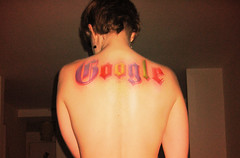
Digitial Natives — Is Your Google Tattoo Showing


Tattoogle
Originally uploaded by lowereastside

Last week I gave a lecture to Dennis Price’s MBA class on social media. It was great fun (for me), and I hope, beneficial for the students. One of the questions that kept coming up was "why do you blog" — or more precisely, what is the value model that drives/informs my blogging.

My standard response is this — blogging provides me with a disciplined approach to creativity, innovation and writing. This blog is a scrapbook of my ideas that I use to map and document my thinking, often returning to an idea months later. This makes my blog, for me at least, a veritable feast of content and concepts — though sometimes the connections between ideas and actions, between strategies and activations are less than clear. Often this is because I am wanting to provoke potential methods of activation, not constrain them.

Often an idea will come upon me unexpectedly. In this situation, I normally login to the blog and type up a one line or one paragraph entry. If there is a link I will include it. Then I publish this as a draft. Later, when I have more time, I return to the draft to think it through and provide some context.

One such draft that I have been meaning to return to is this one. It is on the concept of digital natives, and in particular, on the podcast between two very clever social media thinkers and commentators — Anna Farmery and Paull Young. And while I admit that there are problems with the terms "digital native" and "digital immigrant", they do provide a starting reference to form a conversation as you will notice in Show #136 of Anna’s The Engaging Brand podcast.

I won’t spoil the podcast for you, but there are some excellent points that Paull and Anna make, including:

  • The identity of digital natives is in flux (as it is for all of us in our early 20s) — and as such it is not yet aligned with our profession. This means there is a focus on the way that "work" and "life" co-mingle
  • One of THE most important aspects of job choice is the opportunity to work with friends (or to make friends)
  • This brings a special focus on the alignment of PERSONAL values and BUSINESS values. For businesses wanting to attract and retain digital natives, this touches concepts such as corporate social responsibility, flexible working conditions and accelerated responsibility
  • Digital natives are impatient for outcomes. They are caught between wanting to overcome barriers to action (short term achievement) and achieving longer term beneficial change in the workplace and the world.

There are many other great points raised through the podcast, so it is well worth a listen (or you could simply subscribe to Anna’s iTunes store). Paull mentioned that the digital natives are the first generation to be born with a Google Tattoo (he attributes this to Geoff Livingston). Think about that from a brand point of view. Listen to the podcast. How is understanding that level of commitment going to impact your hiring practices (it should), how will it change your search for talent (it will) and why will this transform the marketplace for your products and services (it already has)?

Remember, if the digital natives have a Google Tattoo showing, then the digital immigrant also displays the marks of their history. How are your markings influencing your future strategies and visions? Perhaps it is time to recast our ideas and approaches.

Measuring Audience 2.0


  Eyeballing 
  Originally uploaded by fotologic

So I am sitting there in a meeting in a far-off Asian country. Seated all around me are marketing managers and directors from my client’s company. My colleagues and I are slightly jet lagged but hyped — the countdown to our presentation is only minutes away. We just have to wait through one more presentation on "digital strategy" from another agency. The irony is not lost on us … we are, after all, about to present a solution to the challenge of digital strategy — and we feel like we have nailed it.

Then it starts. Well, I thought — "I don’t know a lot about digitial". Hmmm. "But what I do know, is you can’t measure it". What? I stifle the intake of my breath. This is not the time. This is not the place.

To my surprise I look around the room and observe a sea of nodding heads. Not a dissenting voice. Not one.

As I mentioned in this post on measurement some time ago, the idea of tracking hits and even page views seemed quaint and outdated. But what if there really was an AUTOMATED way of measuring what your audience … or what your PARTICIPANTS were interested in? What if you could use this to refine your site/project/marketing efforts — on the fly?

Josh Catone has an interesting article on the new Alenty  site engagement measurement tool. Sure it seems to be focused on banners, but I have a feeling that it would be much more beneficially deployed under the hood of your community system. Imagine if Microsoft turned this on for Facebook? How about a widget for Typepad that allows bloggers to tap into the data about their blogs? Or imagine what this would mean for game developers?

In the future, this sort of technology will be mandatory for all branded content. Not only that, when combined with upstream and downstream analytics, the potential for us all to understand what works, what doesn’t and the IMPACTS of our cohesive branding, design and experience efforts will transform the business of branding. And yes, it really is all about the audience. Don’t let anyone tell you otherwise.

Kevin Rudd Announces Australian 2020 Summit


Kevin Rudd
Originally uploaded by nicholasjohnfield

Laurel Papworth follows up on PM Kevin Rudd’s announcement of a 2020 Summit this April — to discuss directions ahead for the next 10 years. See unembeddable video here (c’mon ABC, get with it).

The summit that will bring together 1000 of Australia’s brightest minds will cover:

  • Future directions for the economy, including education, skills, training, science and innovation (this one interests me most
  • Economic infrastructure, the digital economy and the future of Australia’s cities (but I am loving this too)
  • Population, sustainability, climate change, water
  • Rural industries and communities
  • National health strategy
  • Families, communities and social inclusion
  • Indigenous Australia
  • The future of Australia’s arts, film and design
  • Democracy, open government, the role of the media, the structure of federation, citizens’ rights and responsibilities
  • Future security and prosperity

(Source: Prime Minister’s office)

Laurel is voting for Mark Pesce and for herself (which is fair enough — check out her new profile).

It is great to see some big picture agenda setting. But is there anyone else out there you would like to see in the 1000 strong delegate list? Oh, and do blog this and link to Laurel’s post — we want to make sure that Australian digital media has some representation — even if it is only on Google.

UPDATE: There are a bunch of other folks talking this up:

Stephen Collins – setup 2020Summit.org so we can all talk it up
Prime Ministers Media Release
Tim Longhurst blog
SmartCompany article
Stephen Collins blog post
Freedom to Differ blog
Nick Hodge nominates Laurel
Peter Martin blog
Tangler forum

Web Trends in Beta

Iawebtrends Hot on the heels of Ross Dawson’s trend predictions for 2008 comes the IA Web Trends 2008 — in Beta (with thanks to Jen from Innovation Feeder). There are obvious design similarities here (I believe the IA folks from Tokyo were inspired by Ross’ efforts last year), but this map has a different focus. It is more to do with the brands behind the trends, with the trends variously appearing as place names or features.

And one thing I do like is that this is in Beta. That’s right, if you feel that something is missing, you can submit a site for inclusion. I can’t guarantee that your nomination will get in, but there are some big players and some emerging trend makers that seem to be missing. Is there someone or some site you feel deserves a spot?

Forget Influentials, Embrace the Curious

Yesterday’s post on Influentials generated some great comments and got me thinking (yet again) … and this is where it is going …

Process Over Targeting
In building your marketing/digtial strategy and beginning to execute, the challenge is not in the targeting, but in establishing a transmissable message. It is about creating a flow between participants in the conversation about your brand. As David Reich says, "… if Watts is right about the randomness of who the influentials are, then it’s difficult to accurately target them". This means that focusing on process rather than targeting will allow you to capitalise on network/word of mouth effects as they occur. It makes your message RESILIENT.

Conversation Affects the Network
Mike Arauz raises an interesting point. What happens to the entire network as conversation takes hold? I have no data to back this up, but I have a feeling that by activating the network of weak links that the network itself becomes more susceptible to the trend. This is almost the reverse of a network of influence … it is bottom up. With her interest and expertise in network dynamics, I would love to know what Leigh makes of this idea.

The Curious Are the New Influentials
Again, no data on this, but contagion, or idea spreading (or as Seth Godin would say, "the ideavirus") seems to occur not with the influencers, but with the curious. That is, those individuals who are interested in "things", who seek out, who suspend judgement and criticism — it is "the curious" who are responsible for sparking trends and initiating their broad acceptance. Take a look at this great clip featuring Seth Godin — five minutes of insight thanks to Mark Hancock.

Where does curiosity come from? "Perhaps somewhere beyond my cleverness". I wish I wrote that!

Update: Seth Godin chimes in on Duncan Watts’ article.